
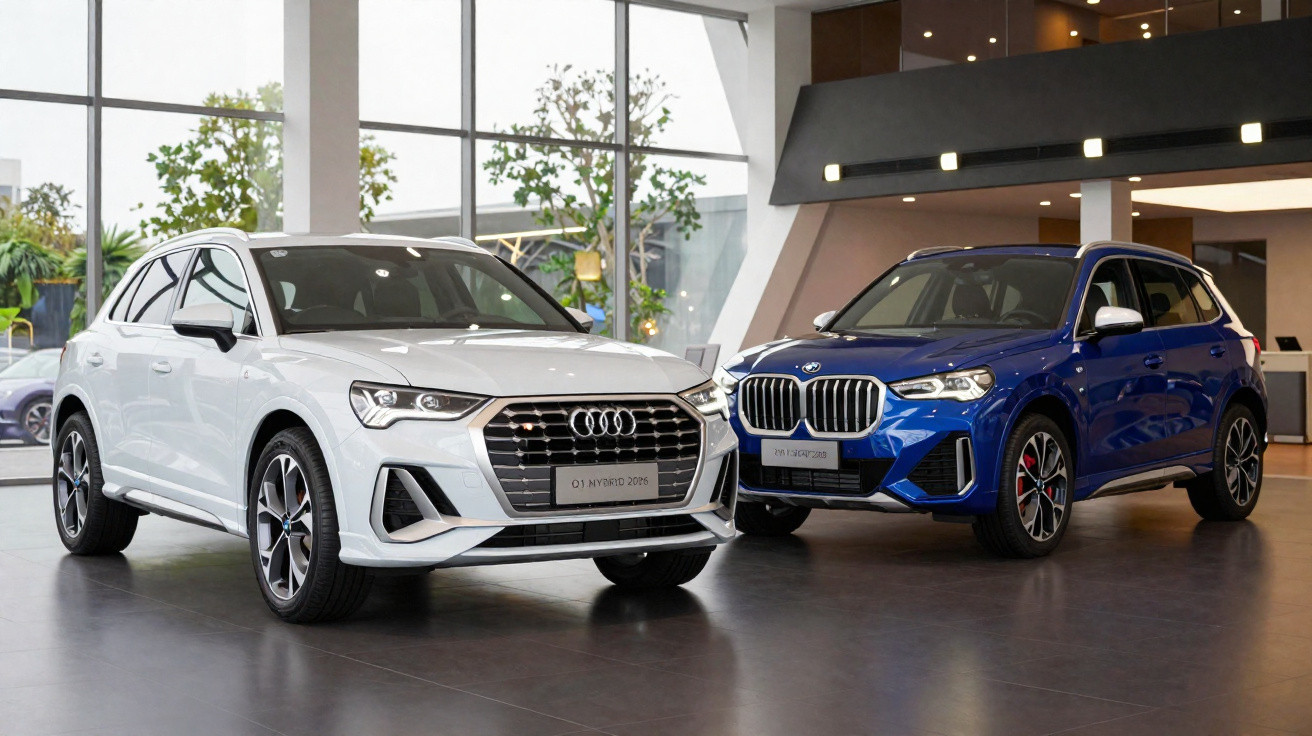
000 euros – yet in day-to-day driving only one of them really feels fully cohesive.
One arrives fresh in its third generation, the other is an established best-seller. For 2026, the Audi Q3 TFSI 150 Hybrid S Line and the BMW X1 sDrive20i 170 M Sport go head-to-head with comparable output, broadly similar pricing and a clear premium brief. On the spec sheet they look closely matched; on the road – and when you start paying the bills – the differences become far more obvious.
Concept and technology: two routes to a premium compact SUV
Both contenders are aimed at buyers who want a compact SUV with strong badge appeal, up-to-date tech and running costs that remain reasonable. Even so, their engineering approaches diverge in key areas.
- Audi Q3 TFSI 150 Hybrid S Line: 1.5-litre four-cylinder petrol, 150 PS, mild-hybrid system, front-wheel drive, dual-clutch gearbox.
- BMW X1 sDrive20i 170 M Sport: 1.5-litre three-cylinder petrol, 170 PS, mild-hybrid, front-wheel drive, automatic.
At first glance the Audi looks like the better deal: it starts at 43.850 €, albeit in the plainer Design trim. The S Line tested here edges close to the 50.000 € mark even without extras. The BMW, in contrast, begins as the sDrive20i M Sport at 50.900 €, but brings noticeably more visual sparkle as standard.
"On paper the Audi looks cheaper, but in reality the two quickly end up on the same price shelf."
Interior and quality: BMW brings more theatre, Audi more logic
Materials and perceived quality
Step inside and the first clear point goes to BMW. In M Sport trim, the seats, trims and fabrics come across as a class more premium. Alcantara upholstery with blue contrast stitching is standard and continues into the dashboard. The X1 delivers that “I’m in an expensive car” sensation many buyers in this segment expect.
The tested Q3 cabin feels more restrained by comparison. The seats’ cloth upholstery and the inserts in the doors suggest solid mid-market rather than a high-end SUV. Nothing comes across as cheap – it just doesn’t feel especially special either.
Controls and infotainment
When it comes to usability, the tables turn. Audi’s central screen impresses with a clean layout, smooth graphics and menus that make sense. Key functions are only a few taps away, and the touchscreen responds promptly.
BMW’s interface looks modern, but it sometimes buries functions deeper than necessary. One example: the “Personal” drive mode implies open-ended customisation, yet it cannot be configured as freely as you might expect. Instead, finer settings are tucked away within Sport mode. High-mileage drivers in particular may find that inconsistency frustrating.
"If you want a more upmarket atmosphere, you’ll find it in the BMW. If you don’t want to fight through nested menus, you’ll feel more at home in the Audi."
Space and boot capacity
In the rear, both SUVs use a sliding back bench, allowing you to trade legroom for load space. With the bench pushed fully back, the BMW X1 offers slightly more knee room. Adults sit more comfortably, and children benefit from the airier feel.
In boot space the Audi hits back hard: with 550 dm³ versus 466 dm³ in the BMW, the Q3 offers significantly more luggage capacity – a strong argument for families or sporty hobbyists who often carry bulky kit.
| Model | Power | Starting price | Tested price (without extras) | Boot | Cylinders |
|---|---|---|---|---|---|
| Audi Q3 TFSI 150 Hybrid S Line | 150 PS | 43.850 € | ca. 50.000 € | 550 dm³ | 4 |
| BMW X1 sDrive20i 170 M Sport | 170 PS | 50.900 € | 50.900 € | 466 dm³ | 3 |
On the road: three cylinders versus four
Engine character and noise refinement
On paper, the BMW seems disadvantaged with “only” three cylinders. In real driving, that very engine leaves the stronger impression. From cold you briefly hear the familiar three-cylinder thrum, after which the X1 runs surprisingly smoothly. At normal speeds the BMW also feels better insulated, keeping the cabin quieter.
Floor the throttle and the three-cylinder makes itself heard again, but it sounds eager and rev-happy. Audi’s four-cylinder is refined too, yet it delivers its performance in a much more linear manner – almost a touch too well-behaved.
"The BMW three-cylinder sounds like a compromise on paper, but on the road it feels like the more grown-up solution."
Performance and suspension
In outright pace and in-gear response, the BMW pulls clear. Over the standing-start kilometre it is almost two seconds ahead of the Q3. In everyday driving you also notice how much more promptly it reacts to throttle inputs. The mild-hybrid assistance is more evident as well, both when accelerating and when recuperating.
Both test cars run on 19-inch wheels with sportier tuning. Around town they ride on the firm side, though without becoming uncomfortable. As speeds rise, the BMW smooths out imperfections more effectively while still feeling planted and substantial. The Q3 remains competent but doesn’t reach the same level of polish.
Tyres play a role in available grip: the X1’s Pirelli P Zero rubber delivers strong traction, especially in the wet. The Audi was fitted with Bridgestone Turanza tyres and relinquished front-axle grip a little sooner under a heavy right foot.
One area where the Audi claws back ground is braking. From higher speeds, the Q3 slows down with more bite – welcome news for motorway drivers.
Costs and options: the expensive playground of extras
Budget differences don’t show up only in list price – they are amplified by the options catalogue.
- Audi Q3 test car: around 3.100 euros in extras (paint, wheels, black accents, tinted windows).
- BMW X1 test car: around 14.750 euros in extras (including electric seats, heated steering wheel, glass roof).
In theory, the Q3 can be loaded with more than 20.000 euros of optional equipment. The X1 reaches its ceiling earlier, typically around 15.000 euros. Even then, both models can demand hefty surcharges for comfort items such as keyless access or expanded driver-assistance systems.
"If you click carelessly in the configurator, you can turn a 50.000-euro SUV into a 70.000-euro SUV very quickly."
There is more: the ecological surcharge based on CO₂ emissions is slightly higher for the Audi. On top of that, in testing the Q3’s fuel consumption sat marginally above the X1’s, whether in town, on country roads or on the motorway.
BMW’s advantage comes with one small blemish: its tank capacity limits touring range. With a full tank, around 650 kilometres in one stint is realistic. That will suit most drivers, but long-distance commuters will find themselves stopping to refuel more often.
Strengths and weaknesses at a glance
BMW X1 sDrive20i 170 M Sport – strengths
- Strong ride comfort, particularly at cruising speed.
- Very high-quality ambience in the cabin.
- Generous space in the second row.
- Responsive engine with clearly noticeable mild-hybrid assistance.
BMW X1 sDrive20i 170 M Sport – weaknesses
- Operating logic with menus that can be confusing in places.
- Three-cylinder sound on cold start and at full throttle is a matter of taste.
- Digital instruments don’t quite look premium in their graphics.
Audi Q3 TFSI 150 Hybrid S Line – strengths
- Highly usable central display with a logical structure.
- Largest boot in this comparison, ideal for family life and leisure.
- Strong, fade-resistant braking performance at higher speeds.
Audi Q3 TFSI 150 Hybrid S Line – weaknesses
- Noticeably weaker performance.
- Narrow-looking instrument cluster with less perceived quality.
- Firm low-speed rolling comfort.
The clear winner in the 2026 SUV duel
Set side by side across all disciplines, the decision is less tight than the similar pricing suggests. For driving dynamics, comfort, noise levels and perceived quality, the BMW X1 comes out in front. Even the much-scrutinised three-cylinder concept turns into a plus point here, because the engine simply feels better suited to everyday use.
The Audi Q3 answers with clear strengths. If you need every last centimetre of luggage space, or you place a high value on an infotainment system that’s genuinely intuitive, the Q3 remains a compelling package. In braking performance it even briefly edges past its rival. Yet that strength alone is not enough to erase the gap in drivetrain response, overall comfort and how the pricing structure plays out.
"In the overall picture, the BMW X1 sDrive20i M Sport 2026 presents itself as the more rounded, more mature offer in the premium compact class."
What buyers should pay closest attention to now
With SUVs like these, the right configuration can make or break everyday usability and resale value. Driver-assistance systems, matrix lighting, a heat pump, adaptive cruise control or a heated steering wheel: all of it costs money, but it can massively increase day-to-day value. If you plan carefully, you’ll combine a few key features rather than ticking every design gimmick.
It also pays to be honest about your driving profile. If most of your miles are in the city and on short trips, you’ll benefit from the BMW engine’s sharp response and the comfort of its suspension. If every weekend involves a pushchair, a dog and lots of bags, you’ll appreciate the Audi’s larger boot and may consciously accept a little less punch.
And one factor that is often underestimated: the control philosophy. Long-distance commuters don’t want to battle through layered menus every day. If you regularly use many functions, take the time to try both systems properly at the dealership. A clear layout and readable displays save your patience in the long run – and can sometimes matter more than an extra 20 PS.

Comments
No comments yet. Be the first to comment!
Leave a Comment