
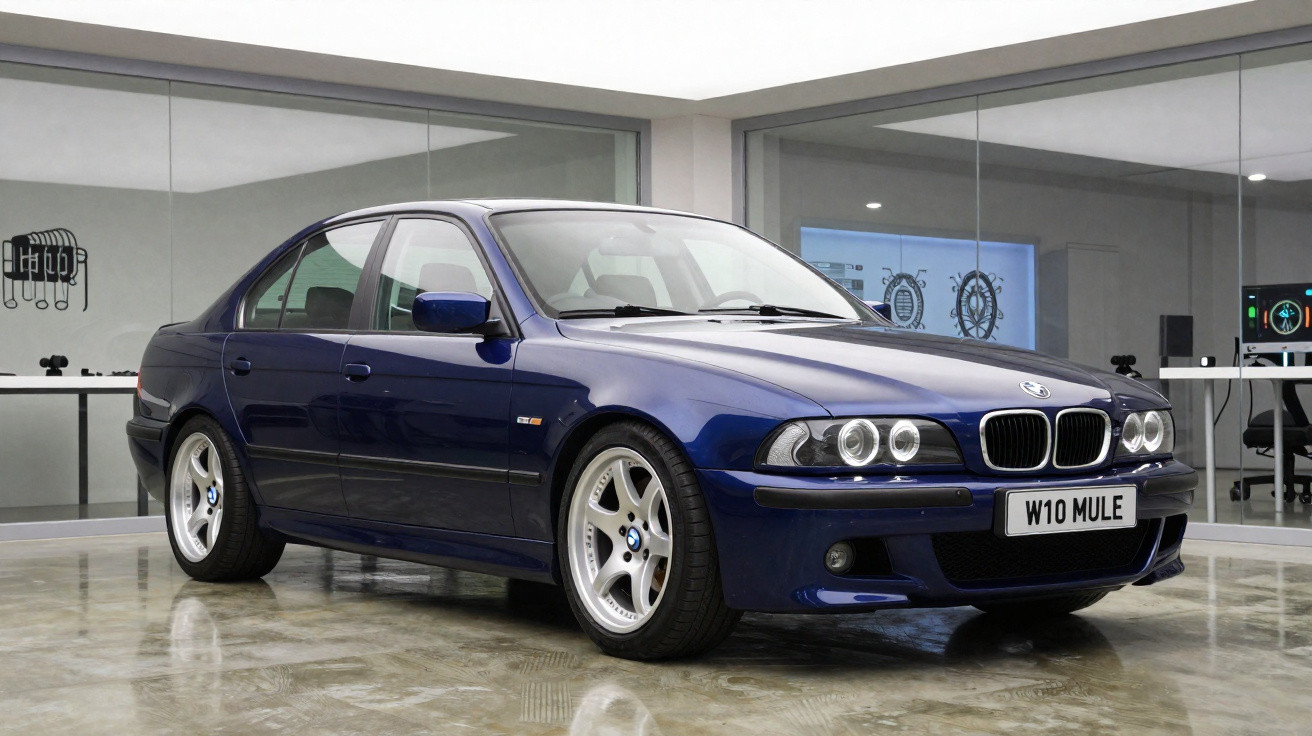
Almost two years ago, we learned that a BMW M5 E39 existed with a Volkswagen W10 engine under the bonnet. Yes, you read that correctly… a “W” engine rather than a “V”, and with 10 cylinders.
This M5 was the test mule chosen by Volkswagen engineers to trial the unusual unit - created by combining two VR5s - yet in the end the intriguing W10 never made it into series production.
Based on information circulating online, there are only three examples of this W10 block in existence - and the video shows the bare 10-cylinder unit. One of them is installed in this BMW M5 E39, and it is the only one known to be running.
The outcome of this unlikely pairing was so convincing that the famously uncompromising Ferdinand Piëch - then head of Volkswagen - apparently ended up using the test prototype as his personal car.
Now, Britain’s DriveTribe explores the story in far more detail, filling in the gaps. Better still, they tracked down the M5 W10, drove it and even put it on a rolling road:
The W10 has Ferdinand Piëch written all over it
As well as being central to turning the Volkswagen Group into the powerhouse it is today, Piëch also proved himself as an engineer. His CV includes cars such as the Audi Quattro and the Porsche 917 and, without his insistence, we would never have had the Bugatti Veyron (with a W16).
All of those projects share his fixation on innovative - sometimes downright exotic - technical solutions. Volkswagen’s W engines only went as far as they did because of him.
The W10 engine was a direct offshoot of Volkswagen’s “W” engine family, which included the W8, W12 and W16. The W10 was not the only concept left on the shelf; there was also a W18 that never reached production, despite being seen in one of the prototypes that foreshadowed the Veyron.
How much power does it have?
When the existence of this engine became known - and, above all, of the test mule in the shape of a BMW M5 E39 - the biggest question was what figures this unit could deliver.
Even the seller - yes, the BMW M5 W10 is still for sale - speculated that the naturally aspirated engine would produce between 450 cv and 500 cv (and 550 Nm). DriveTribe has now settled the matter by taking it to a rolling road.
The result? It delivered 480 cv, neatly matching those estimates. That is 80 cv more than the M5 E39’s 4.9 V8, with a weight penalty of around 40 kg - it shouldn’t have any trouble getting a move on…
Why use a BMW M5 as a test mule?
At the time, the Volkswagen Group had nothing comparable in its own line-up to a BMW M5 for testing an engine with the potential for 500 cv.
The BMW M5 E39, by contrast, ticked every required box: room in the engine bay, the right layout (longitudinal engine and rear-wheel drive) and a manual gearbox. It also had a benchmark chassis to keep everything under control.
The aim was also to assess, discreetly, how the W10 would behave in real-world conditions - away from the prying eyes of the press and rival manufacturers.
A BMW testing a Volkswagen engine would have been unthinkable at the time, which made it the perfect disguise. On top of that, the M5 E39 is understated enough that it would be easy to mistake it for a more “ordinary” 5 Series.
In the video, you can also appreciate the care taken when fitting the W10 into the BMW M5 E39 - it almost looks like a production car. Subtle modifications are visible, but they do nothing to change the M5 E39’s original appearance, while concealing an absolute rarity.
Comments
No comments yet. Be the first to comment!
Leave a Comment