
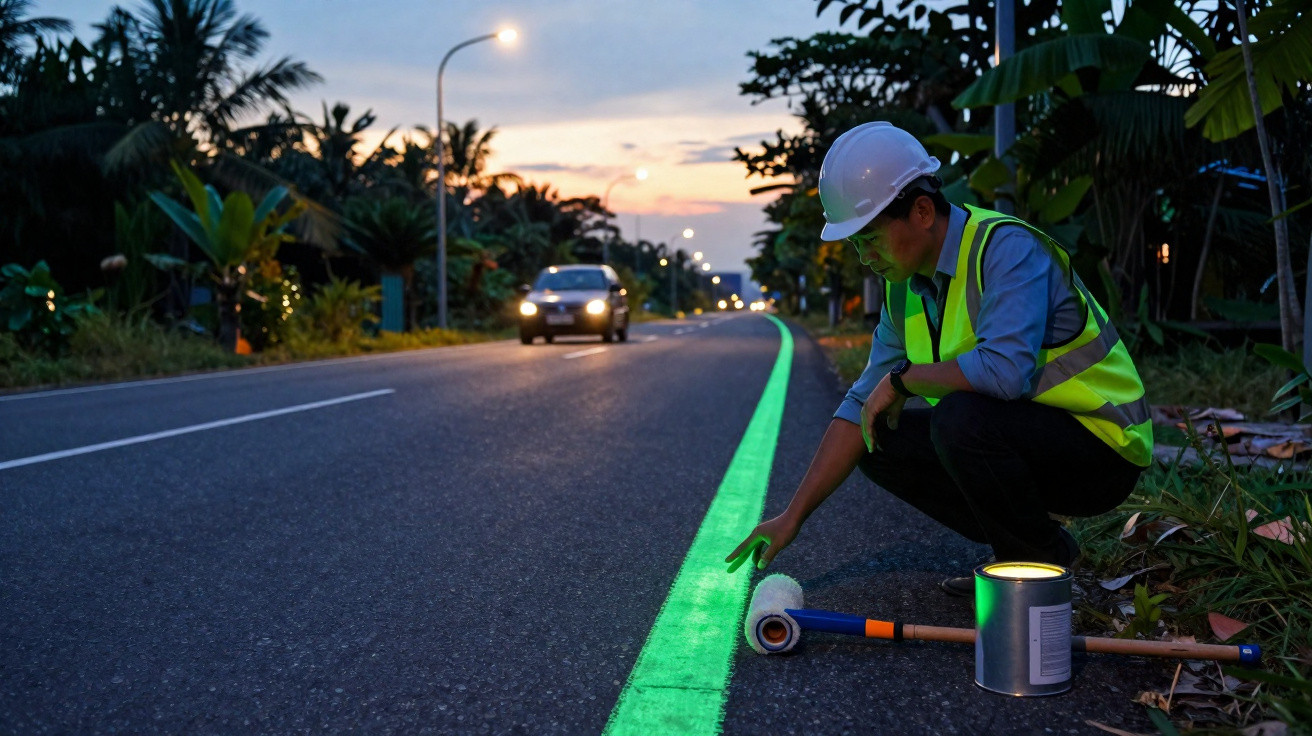
Soon after, the dream burst.
What started as a futuristic road-safety test without conventional street lights turned, within a few months, into a case study in how unforgiving figures, standards and real-world maintenance can bring even the slickest transport idea to a halt.
How an unremarkable rural road became a future project
The experiment took place on a two-lane road near Semenyih in the state of Selangor. At the junction of Jalan Sungai Lalang and Jalan Sungai Tekali, there were no traditional street lamps at all-precisely the gap Malaysia’s Public Works Department chose to target.
Rather than installing new columns and cabling, the team opted for road markings painted with photoluminescent paint. This specialist coating absorbs light during the day and releases it again after dark. The test section measured 245 metres, and according to officials a total of 490 metres of markings were freshly applied-centre lines, edge lines and guidance points.
The promise was clear: lane lines that remain plainly visible at night, without electricity and without expensive lighting columns.
The project was presented as a road-safety measure. Those responsible stressed it was not a publicity stunt but “innovation in road construction”. In rural areas with limited lighting, clear lane guidance is vital-especially in rain, fog and night-time driving.
Early reactions: enthusiastic drivers, ambitious plans
News of the test spread quickly. Coverage in Malaysian media and on car forums was largely upbeat. Many drivers said they felt safer on the unlit stretch because the road alignment seemed to hover in front of them.
The responsible minister, Alexander Nanta Linggi, said the glowing markings could remain visible for up to ten hours. Even in rain, he argued, they still produced an effect that was easy to make out. While the ministry continued gathering data on cost and performance, the mood was optimistic.
In Selangor, the idea of scaling up took shape early. At the beginning of 2024 the state announced plans to deploy the technology at 15 further sites across all nine districts. The programme envisaged roughly 15 kilometres of marked roads, including in Sepang, Kuala Langat and Petaling. The estimated budget: around 900,000 Malaysian ringgit.
Other states also wanted a say. Johor put forward 31 potential test roads, including a 300-metre section in Batu Pahat. A local pilot rapidly became a nationwide discussion: could glowing paint partly take over the job of street lighting?
The catch: a brutally simple cost calculation
The closer finance teams looked, the less comfortable the picture became. Photoluminescent paint was, quite simply, extremely expensive. Government figures put the specialist coating at about 749 ringgit per square metre. Conventional road-marking paint, by contrast, was around 40 ringgit per square metre.
That made the futuristic option almost twenty times more costly-before durability and upkeep even entered the conversation.
For a transport ministry working within a limited budget, that gap is enormous. Road markings require regular renewal; rain, sun and traffic continually wear down the surface. A strong first impression is of little value if the glow fades quickly and fresh multi-million outlays are needed again and again.
There is also the question of compliance: standard road markings are governed by strict technical requirements, including performance in wet conditions, when dirty, and under headlight illumination. Photoluminescent coatings must clear the same bar. If they look impressive yet perform worse in fog or with heavy soiling, that becomes a safety risk.
The parliamentary line that changed everything
By November 2024, the tone had clearly shifted. Deputy Minister of Works Ahmad Maslan told Parliament that the glowing markings were simply too expensive. The project would probably not continue.
His second point was at least as consequential: the tests had not fully convinced the ministry’s specialists. That restrained wording carries weight. From an agency perspective, positive driver feedback is not enough if experts identify shortcomings in the detail-whether in visibility distance, wear rate or application quality.
The concept looked modern and made for great headlines, but it collided with standards, maintenance demands and budget reality-a classic infrastructure dilemma.
The once-celebrated pioneer stretch therefore reverted to what it had always been: an experiment. Not a new norm, not a revolution in road building, but a time-limited test site.
A look to Europe: examples with a limited lifespan
Malaysia was not alone in pursuing the idea. In the Netherlands, the “Smart Highway” project by artist Daan Roosegaarde and construction firm Heijmans generated international attention. There too, glowing lines were used, intended to “charge” in daylight and shine for several hours at night.
The Dutch pilot section was limited to three months. Reports said the lines remained visible for up to eight hours. Even so, the project largely faded from view afterwards. Here as well, questions emerged about durability, cleaning effort and resistance to weather.
The pattern is familiar: roads that glow without electricity sound brilliant on paper, but run into multiple obstacles in day-to-day use.
Why glowing roads struggle to become everyday reality
- High material costs: specialist paints cost far more than standard markings.
- Uncertain service life: how quickly do sun, rain and abrasion reduce the glow?
- Demanding standards testing: safety rules require dependable visibility in widely varying conditions.
- Maintenance and cleaning: dust, rubber residue and oily films dampen the effect and must be removed frequently.
- Competition from LEDs: efficient LED street lighting keeps getting cheaper and easier to control.
What the trial still made clear
Even if a nationwide roll-out is off the table for now, the underlying challenge remains: authorities around the world are looking for ways to improve night-time visibility on poorly lit roads without locking in permanently high energy costs.
Japanese research bodies-such as the National Institute for Land and Infrastructure Management-work extensively on maintenance criteria for road markings. In that context, visibility is treated as a core pillar of road safety, not a side issue.
The Malaysian trial contributes useful data: how drivers respond, how accident figures change, and how glowing strips hold up in rain, in glare, and when the surface is lightly soiled. Even an outcome of “not good enough” helps future solutions become more targeted.
Where such roads could still make sense
That is why the technology is not necessarily finished. Highly targeted use is conceivable in places where full street lighting is difficult to deliver:
- short, hard-to-read bends in mountain regions
- approaches to bridges or tunnels away from built-up areas
- temporary diversions or roadworks zones
- school corridors in rural regions with low traffic but a high need for protection
On brief sections, the cost disadvantage may matter less, while the visual effect can be deployed deliberately to heighten attention. Combinations are also plausible: conventional reflective markings plus specialised glowing zones at critical points.
What terms like photoluminescent paint actually mean
Photoluminescent paint contains pigments that absorb energy from light and release it gradually over time. Unlike reflective beads, which merely return light from headlamps, the material genuinely continues to emit light on its own.
Most people recognise the effect from emergency exit signs, underground-station markings or glow-in-the-dark stars in children’s bedrooms. Roads, however, face much harsher demands: the layer must withstand tyres, de-icing salts, heat and tropical downpours-over years, not just a few months.
That is the core challenge. The more resilient the formulation, the higher the price tends to be. And the more intensive the cleaning and upkeep, the more follow-on costs rise-costs that often disappear behind the initial marketing shine.
What Europe can learn from Malaysia
German-speaking countries face similar pressures: saving energy, cutting light pollution and maintaining road safety. Smart street lighting, partially dimmed LED lanterns and sensor-controlled systems all compete with ideas such as glowing carriageways.
The Malaysian pilot shows why it is sensible to test new technologies on a very limited scale first, gather evidence and then discuss it openly. The temptation to turn futuristic images into major programmes is strong-and so is the disappointment when everyday reality does not cooperate.
For councils in Germany, Austria and Switzerland, the example from Semenyih can serve as a warning: innovation in road construction requires not only creativity, but also patience with standards, long-term costs and maintenance. Glowing roads on their own do not solve the problem of dark rural routes-they mainly reveal how complex the task really is.





Comments
No comments yet. Be the first to comment!
Leave a Comment