
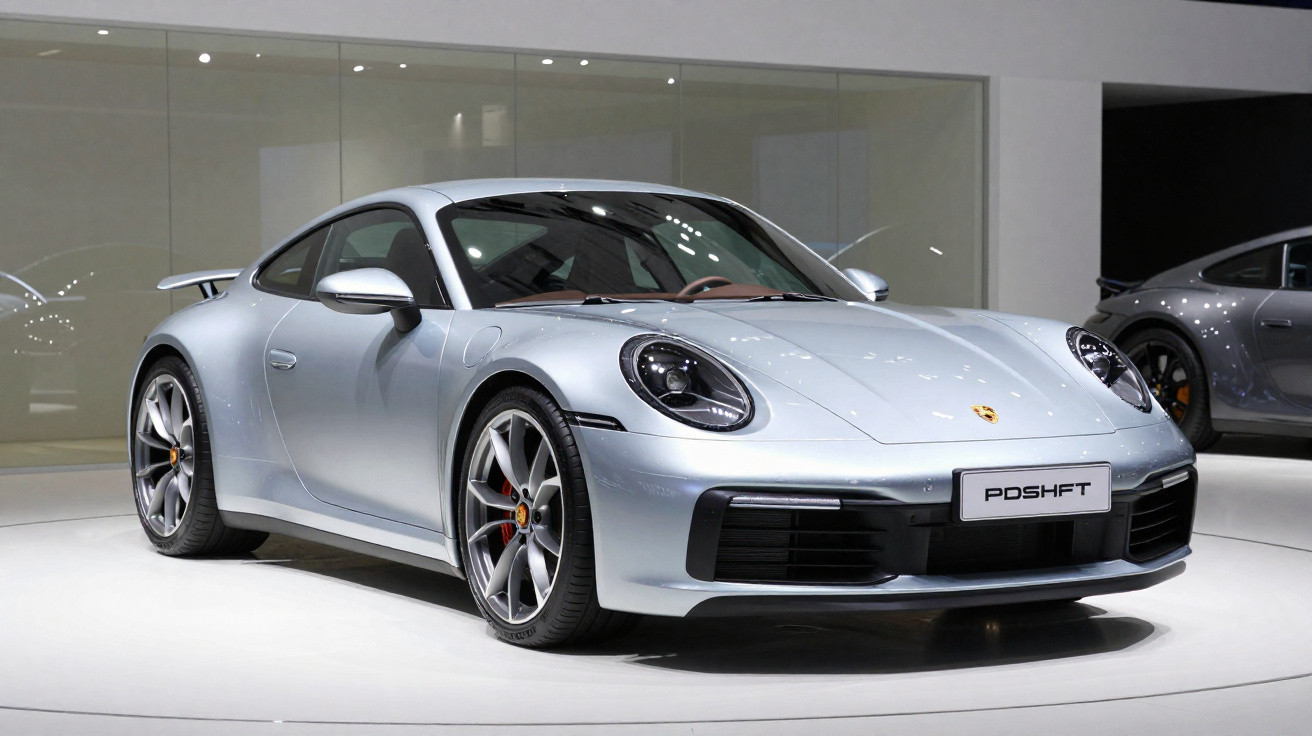
Porsche enthusiasts have worried for years that the traditional manual gearbox is living on borrowed time. A patent published in Germany now suggests the brand is developing a gear lever that aims to deliver both worlds: everyday automatic convenience and a genuine H-pattern shift experience for country roads. This is not presented as a marketing gimmick, but as a rethought selector lever concept.
Porsche responds to the slow disappearance of the manual gearbox
Across the sports-car market, the direction of travel is clear: away from a clutch pedal and towards dual-clutch transmissions and torque-converter automatics. Porsche buyers have long been choosing the PDK because it shifts faster, uses less fuel, and feels more relaxed in traffic.
European CO₂ rules add further pressure. Each additional engine-and-gearbox combination has to be homologated separately. That makes a conventional manual harder to justify financially, especially for niche models such as hardcore 911 variants or more purist 718 versions.
To find a way out of that corner, Porsche filed a system with the German Patent and Trade Mark Office on 30 August 2024, which was published on 5 March 2026. In formal terms it is titled “Device for gear selection for a vehicle transmission”. Behind the dry wording sits a notably emotional aim.
The lever is intended to bring back the familiar feel of an H-pattern shift, without a traditional mechanical linkage operating behind the scenes.
How the new Porsche gear lever works
From an engineering standpoint, this is a “shift-by-wire” selector. In other words, the lever is no longer mechanically connected to the gearbox; instead, it sends electronic signals to a control unit.
Even so, the movement pattern mirrors a classic sports-car manual:
- A forward/back movement selects the gear
- A left/right movement selects the gate - as with an H-pattern
- Sensors record the lever’s angle and its lateral position
- The electronics convert that into specific shift commands
The patent drawings indicate two zones: one for the familiar automatic positions D, N and R, and another for numbered gears. The key detail is a lateral locking mechanism.
Two modes in one lever
The selector can operate in two modes:
- Locked mode: the lever can only be pushed forwards and pulled backwards. The driver selects D, N or R, and it behaves like a conventional automatic selector.
- Free mode: the side lock releases. The driver can now move the lever left and right as well, running through a complete shift gate - like a mechanical H-pattern.
In free mode, springs and small electric motors recreate the resistance you would expect from a real shift gate. The intention is that the driver’s brain registers: “I’m really engaging third or fourth gear”, even though, technically, only an electronic command is being sent.
The drivetrain logic remains automated - but what you feel in your hand is meant to be like the old days.
A different approach from hypercars
A comparable idea already exists in the Koenigsegg CC850. There, a complex multi-clutch transmission physically switches between nine automatic ratios and six true manual gears. The driver effectively gets two gearboxes.
Porsche’s route is more pragmatic. Rather than redesigning the transmission, the focus is on the human–machine interface. In principle, this lever could:
- control a PDK transmission,
- operate a conventional automatic gearbox, or
- be integrated into a future hybrid system.
The aim is to restore the emotional appeal of shifting without surrendering the benefits of modern transmission tech. Shift speed, launch control and driver-assistance functions would remain available; the lever simply “translates” the driver’s hand movements.
What it could mean for the 911 and 718
Particularly in the 911, the gear lever is a symbol. Generations of drivers associate it with the shift from city driving to a favourite country road: manoeuvring out of a parking space, then an open stretch ahead, hand on the knob, revs rising, a deliberate gear change.
This patent could preserve that ritual. One plausible usage pattern would be:
- In commuter traffic the car runs in D, fully automatic, with the lever laterally locked.
- When the road turns twisty, the driver unlocks the lever and uses the H-gate as they would in a manual.
- The electronics execute the selected gears while simultaneously monitoring engine protection, revs and drivetrain limits.
Whether this appears first in a 911 line-up or in the next 718 is unknown. A patent is not a production promise; it simply shows the direction the engineering department is exploring. What is clear is the target: customers who want shift feel, but do not want to give up automatic comfort in everyday driving.
Why manufacturers still delete manual gearboxes
Even with ideas like this, the pressure remains intense. Traditional manual transmissions create several challenges:
| Aspect | Consequence for manuals |
|---|---|
| Homologation | Every variant needs separate approval, driving costs up |
| CO₂ testing | More test cycles, and in some cases worse results than modern automatics |
| Sales volume | Only small numbers now, especially in Europe and the USA |
| Driver-assistance systems | More complex calibration with emergency braking, traffic-jam assist and partially autonomous driving |
With high-performance sports cars there is also another factor: modern automatics and dual-clutch gearboxes shift faster and more consistently than even very skilled drivers. On track, outcomes are often decided by milliseconds rather than by the sensation of shifting.
How the ‘trick’ lever might feel day to day
Anyone driving a PDK or a similar system knows the trade-off. In normal use, the automatic makes a strong case: queues, towing, urban traffic - just put the selector in D and let the car do the work. On a favourite route through hilly terrain, many then miss the active involvement.
With a dual-mode lever, daily life could look like this:
- Morning stop-start traffic: selector in the automatic zone, right foot relaxed, the car handles the rest.
- Evening country-road run: a quick hand movement, release the lock, your hand instinctively moves through the gates, and attention shifts back to revs and line.
The deliberate act of locking and unlocking creates a psychological divide: now I’m in comfort mode, now I’m in “driver mode”. That clarity is exactly what many enthusiasts value about traditional gearboxes.
Opportunities and limits of the concept
As tempting as the idea sounds, it comes with real demands. The system has to feel completely trustworthy. If the lever visually suggests an H-pattern, it cannot respond in ways that feel illogical - for example, the driver believes they have selected third, but the electronics interpret it differently.
That means Porsche would need highly precise feedback through the lever. Small motors can mimic detents, while springs can help centre the lever. Ideally, the driver would not notice that electronics have replaced a metal linkage.
It will also be interesting to see how much freedom the software allows. Fully mechanical manuals can, in theory, permit mistakes right up to engine damage. An electronically interpreted H-pattern lever could simply refuse impermissible combinations or soften them. The feel could remain purist, while the consequences become manageable.
For a brand like Porsche, balancing tradition with high tech, this kind of solution fits the brief: your hand reaches for an analogue experience, while the rest of the car stays digitally optimised. Anyone with petrol in their veins is likely to watch such a system closely-especially as the industry moves ever further towards pure-electric platforms with simple drive-mode selectors.
Comments
No comments yet. Be the first to comment!
Leave a Comment