
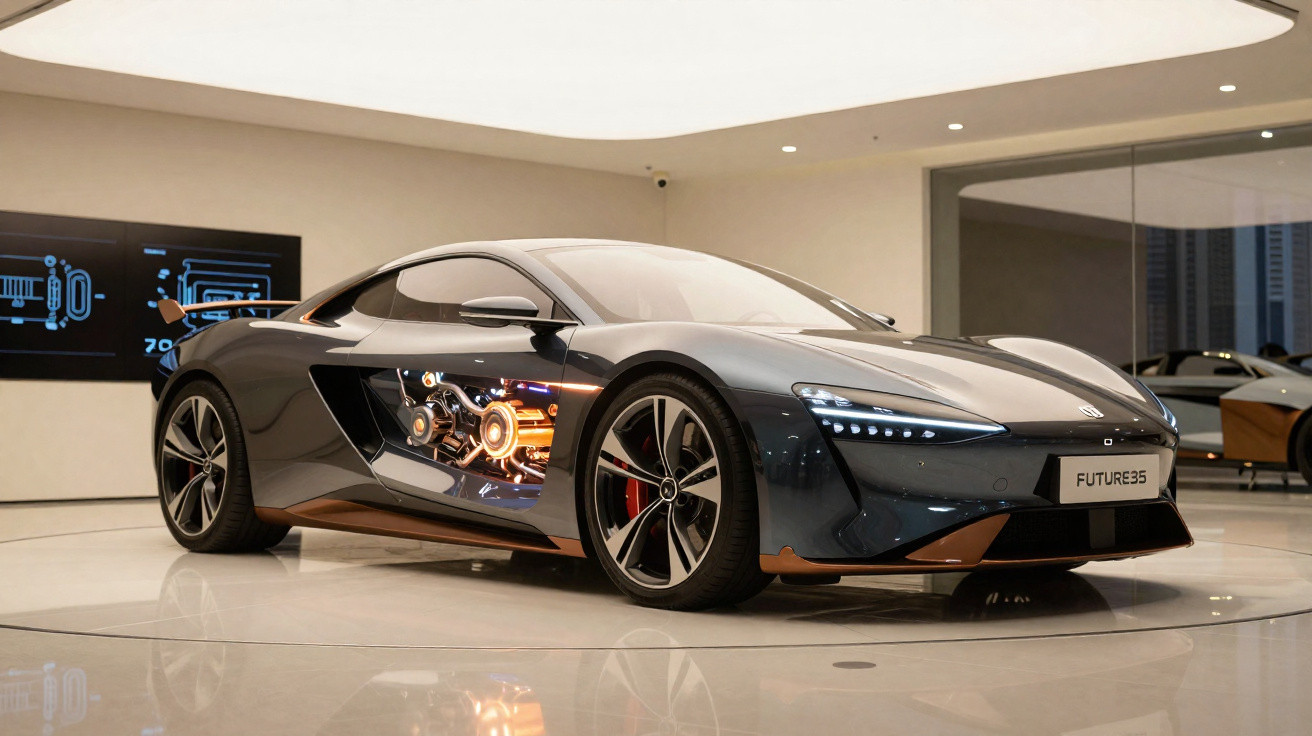
For years, the story sounded all but settled: the car’s future would be electric, and it would arrive sooner than many expected. Events are now forcing that narrative to be recalibrated.
After seeing the European Commission soften its ambitions for 2035, a similar signal has arrived from across the Atlantic. At CES-one of the world’s largest technology shows-Bosch used its platform to underline that most cars sold in North America will still be powered by internal combustion engines in 2035.
Bosch at CES: what it forecasts for North America in 2035
The projection was set out by Paul Thomas, President of Bosch in North America and the company’s top mobility executive, during his on-stage presentation. In his view, as many as 70% of vehicles sold in that market will still use combustion engines.
That does not mean a return to “pure” internal combustion cars. Bosch is not arguing for going back in time-far from it. Thomas said these engines are expected to be paired with mild-hybrid systems, full hybrids, or extended-range solutions where the combustion engine operates only as a generator (electric cars with a range extender).
Even so, this is a clear shift compared with earlier expectations. As recently as 2024, Bosch was pointing to a 40% to 50% share of fully electric vehicles in North America and China by 2030.
Why US electric car adoption is losing momentum
While China has accelerated-today, around half of sales are already electric-the United States is moving the other way. Market share fell below 8% in 2025, edging down slightly from 2024.
A change in political direction, including a pull-back in incentives for electric mobility and weaker efficiency requirements, has directly slowed adoption. In the United States, the pace of EV uptake suffered a sharp drop of 37% in the final quarter of the year. At the same time, battery costs remain a decisive constraint.
It is therefore unsurprising that US manufacturers have revisited their plans, redirecting investment originally earmarked for EVs towards hybrid models and purely combustion-powered vehicles, which deliver better margins.
A more hybrid than electric market for Bosch
Against this backdrop, Bosch is also choosing a practical course. Rather than committing to a single technological pathway, it is continuing to fund multiple tracks-EVs, hybrids and combustion engines all remain central to its plans.
“We have been very balanced in our approach,” Paul Thomas said, stressing that the company is still investing in cleaner, more efficient engines. For Bosch, walking away from that progress would be a strategic mistake.
As a result, the company’s latest outlook is markedly more cautious: a share of only 30% for fully electric vehicles in the North American market in 2035. That figure sits well below what was being discussed a few years ago.
Not everyone accepts this trajectory. Rivian, through its chief executive RJ Scaringe, argues that the biggest obstacle is not demand but supply, insisting that broader choice and more affordable products would speed up adoption.
Bosch’s stance, however, echoes views increasingly heard across the sector and among analysts: the shift to the electric car will take longer, be more complicated, and prove far less linear than many once assumed. For that reason, the internal combustion engine will continue to play a highly significant role.


Comments
No comments yet. Be the first to comment!
Leave a Comment