
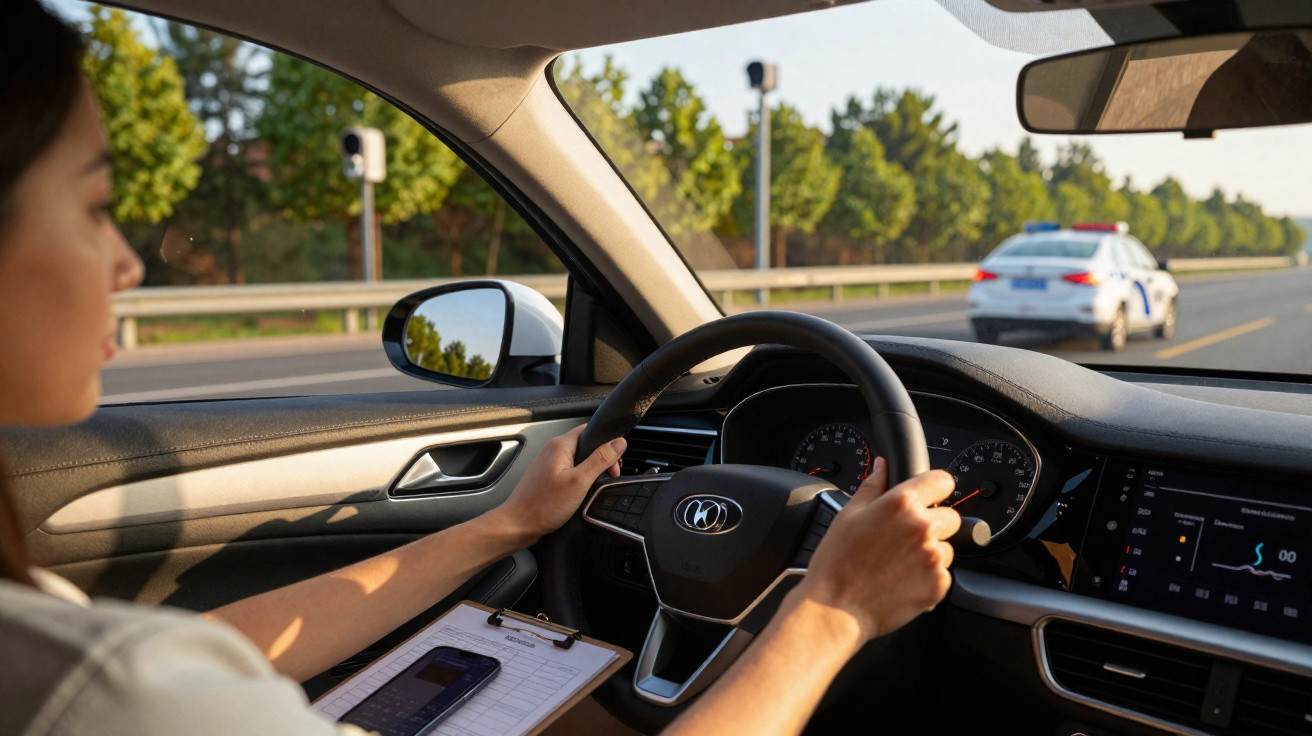
Depending on the radar type and the speed involved, the margin of error is not the same.
You’re driving at 94 km/h on a road limited to 90 km/h and you’re worried a fixed speed camera will flash you? Don’t panic: you may benefit from the margin of error, which can allow drivers to be slightly above the limit without being penalised. That said, this margin of error is not identical for every type of radar, nor at every speed.
A technical margin of error
The margin of error is a "tolerance" applied for motorists, designed to take account of possible inaccuracies in speed cameras or vehicle speedometers. It is set by the authorities and applied by speed cameras installed on roads across the country. It is used to calculate the enforced speed – the one that appears on the penalty notice if you are caught speeding.
It is also referred to as a technical margin because it reflects the measurement uncertainty of speed cameras, which are subject to regular checks to ensure they remain reliable. The most sophisticated devices, such as the Velolaser, are said to be capable of reducing this margin of error to a minimum. Keeping this flexibility also helps to prevent unjustified disputes from drivers who might rely on the difference between the speed shown on their dashboard and the speed recorded by the camera.
This margin of error always works in the driver’s favour – in other words, it is subtracted from the speed recorded by the camera to obtain the enforced speed. As a result, a driver travelling at 91 km/h in a 90 km/h limit will not be flashed, because their enforced speed will be below the permitted speed.
It depends on the radar type and the speed
The margin of error is not the same for all speed cameras, and it is not applied in the same way at all speeds: it depends on the radar type (fixed or mobile) and the 100 km/h threshold.
For fixed speed cameras, which are permanently installed at the roadside (with mandatory warning signage in advance), the margin of error is 5 km/h for speeds up to and including 100 km/h, and 5% for speeds above 100 km/h. If you are driving at 115 km/h on a road limited to 110 km/h, your enforced speed will be 109.5 km/h (115 – 5% of 115), which keeps you out of fine territory.
For mobile speed cameras (carried in police vehicles and used either when stationary or while driving), the margin of error is larger: 10 km/h for speeds up to and including 100 km/h, and 10% for speeds above 100 km/h. For example, if you are travelling at 130 km/h on a road limited to 130 km/h, your enforced speed will be 117 km/h (130 – 10% of 130). Mobile cameras are less precise than fixed cameras, which is why this margin of error is higher.
The margin of error for a fixed speed camera
| Speed limit: | Margin of error | Speeding from: |
|---|---|---|
| 80 km/h | 5 km/h | 86 km/h (enforced speed: 81 km/h) |
| 90 km/h | 5 km/h | 96 km/h (enforced speed: 91 km/h) |
| 110 km/h | 5% | 116 km/h (enforced speed: 111 km/h) |
| 130 km/h | 5% | 137 km/h (enforced speed: 131 km/h) |
The margin of error for an in-vehicle mobile speed camera
| Speed limit: | Margin of error: | Speeding from: |
|---|---|---|
| 80 km/h | 10 km/h | 91 km/h (enforced speed: 81 km/h) |
| 90 km/h | 10 km/h | 101 km/h (enforced speed: 91 km/h) |
| 110 km/h | 10% | 122 km/h (enforced speed: 111 km/h) |
| 130 km/h | 10% | 144 km/h (enforced speed: 131 km/h) |

Comments
No comments yet. Be the first to comment!
Leave a Comment