
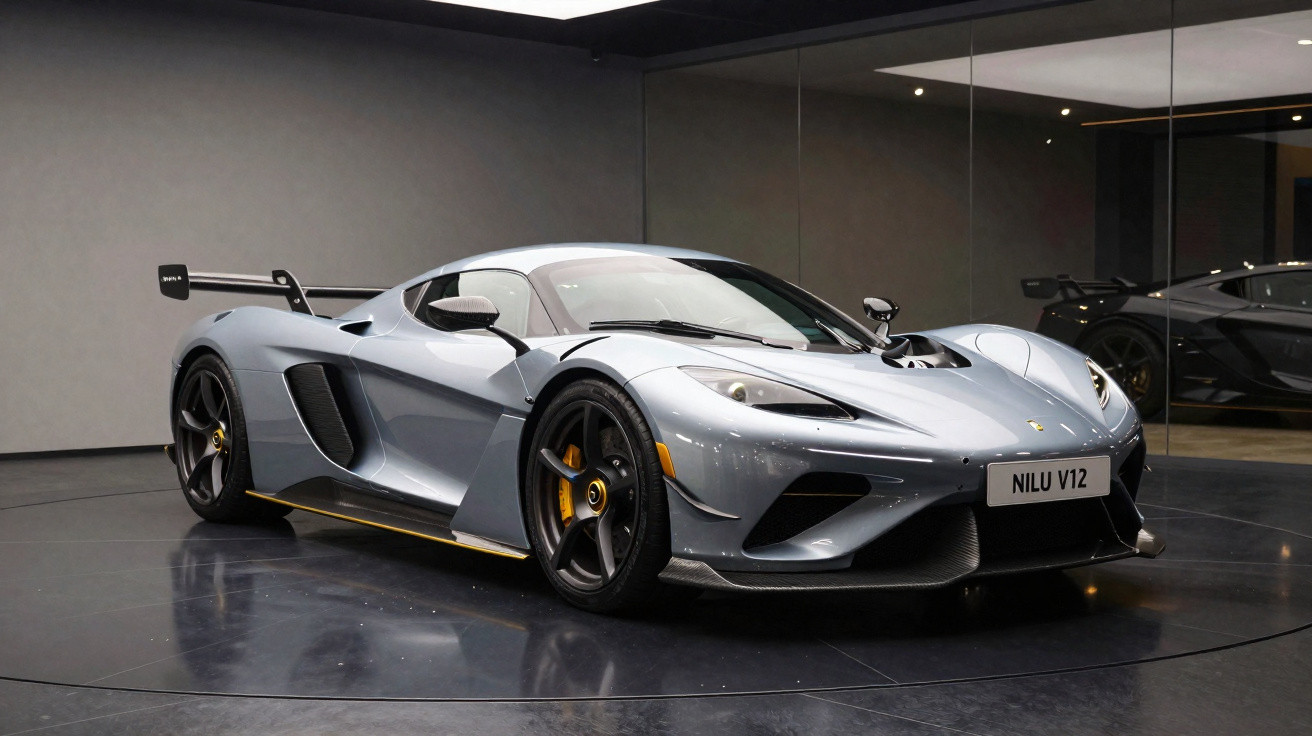
After Gordon Murray Automotive’s T.50, there is another hypercar built for purists that sticks to a naturally aspirated V12 with no electrification whatsoever. It is called Nilu, and it is the first creation from Nilu27, the company founded by designer Sasha Selipanov.
If his name does not ring a bell, his pen was behind the Bugatti Chiron and the Bugatti Vision Gran Turismo, and he also helped shape the final design of the Huracán during his time at Lamborghini.
And the CV does not stop there: before setting up Nilu27, Selipanov went on to lead design at Koenigsegg, signing off cars such as the Gemera and the CC850.
Now, very much in the Horacio Pagani mould, Selipanov has decided to make his long-held ambition real: a self-authored hypercar that serves as an ode to purism, both in how it looks and how it is engineered.
A V12 that’s a work of art
The Nilu refuses to follow the two biggest currents in today’s car industry: digitalisation and electrification. Instead, it doubles down on an analogue formula centred on a mighty naturally aspirated V12 and a seven-speed manual gearbox.
Installed longitudinally in a mid-engined layout, the V12-supplied by New Zealand’s Hartley Engines-uses a Hot V configuration despite having no turbocharging, and it can scream to near 12 000 rpm.
In fact, according to Sasha Selipanov, it is even capable of going beyond 15 000 rpm, but in order not to compromise the balance between performance and reliability, the 12 000 rpm limit felt more… sensible. I cannot believe I just put “sensible” and “12 000 rpm” in the same sentence.
“ This is not a stock engine from any other manufacturer; it’s a custom big-bore short-stroke monster,” said Nelson Harley, founder of Hartley Engines, quoted by Top Gear, before adding: “We want to have cold sweats every time this V12 fires and revs”.
And that is before we get to the figures. Even though the Nilu is built around driver involvement and the emotions it can deliver, its numbers are still enough to put rivals on notice: more than 1013 cv (1000 bhp) of power, and only around 1200 kg.
Even the exhaust is special…
There is more. Just look at the exhaust system, which comes across as a genuine piece of sculpture. Made entirely from Inconel-a nickel-chromium-based superalloy with exceptional resistance to high temperatures-this exposed 12-into-1 setup ends in three commanding central tailpipes.
Under the bodywork, the technical story continues, starting with a carbon-fibre monocoque and a tubular chassis built from an aluminium alloy.
At the rear, beyond the engine and exhaust, the suspension arrangement is also left on display, using a double wishbone and pushrod layout.
Indeed, the entire rear section is left uncovered, laying bare the Nilu’s mechanicals with the kind of precision and exactness you would associate with Swiss high watchmaking. The lower structure alone is a work of art and could easily sit in a museum.
Most of the time, however, it will be framed by bodywork that deserves applause in its own right. The Nilu’s exterior is fluid yet striking, thanks to the many air intakes and crisp creases-each carrying serious aerodynamic intent.
Inside, reached via gullwing doors, it is easy to draw a line back to 1960s Le Mans prototypes-chief among them the Ferrari 330 P4-which helped inspire an interior that is almost entirely analogue. The only screen you will find is the digital rear-view mirror.
And the price?
As for pricing, Selipanov has chosen not to reveal a figure. He has, however, confirmed that Nilu27 intends to build 15 units of the Nilu homologated exclusively for the circuit, before moving on to 54 examples homologated for the road.
The Nilu’s first public appearance is scheduled for next week at Pebble Beach, in California (USA).


Comments
No comments yet. Be the first to comment!
Leave a Comment