
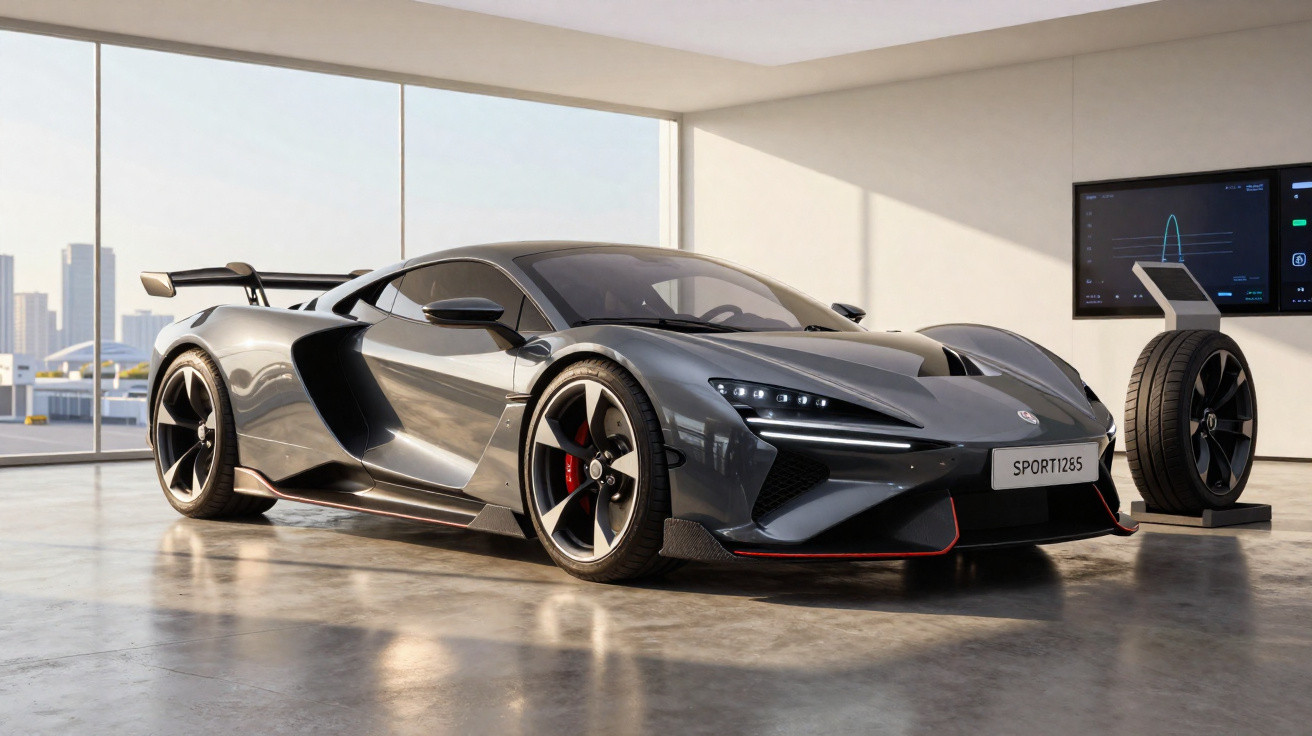
For years, discussions about high-performance cars have tended to circle around the same headline topics: power, acceleration, traction, suspension and aerodynamics. Tyres, meanwhile, have often been pushed into the background-treated as a “consumable”: important, yes, but rarely seen as the deciding factor.
In practice, it works the other way round. Tyres shoulder a huge share of the responsibility for what a car can actually deliver, from safety to handling. And when you start demanding more from a car, the gap between a sport tyre and a conventional tyre stops being theoretical and becomes immediately obvious.
To understand that difference properly, we headed to Mercedes-Benz World, a UK test track, where we had Continental’s SportContact 7-its sport tyre model that won every independent test it entered in 2023 and 2024-alongside two performance cars with a combined total output of 1,265 PS:
- The Mercedes-AMG C 63 S E Performance, a plug-in hybrid with 680 PS and a striking 1,020 Nm of torque available almost instantly;
- And the SL 63 4MATIC+, an all-wheel-drive sports car, with 585 PS sent to all four wheels.
The point wasn’t to pit brands against each other or chase lap times, but to understand how a sport tyre reacts when it is put under real load.
The science of grip with SportContact 7
The starting point is the most fundamental principle in driving: grip. A car’s only physical contact with the road boils down to four patches of rubber, each roughly the size of a postcard. Those small areas have to cope with every force created by acceleration, braking, steering-and the vehicle’s own weight.
Tyres are engineered around different trade-offs: comfort, sporting performance, low noise, efficiency and/or longevity. On most tyre models, the rubber compounds are tuned to deliver a more balanced, everyday level of performance.
With a sport tyre, those priorities shift. A dedicated compound increases adhesion, designed to perform better as the tyre warms up. In the case of Continental’s SportContact 7, that characteristic comes from its BlackChili compound, developed so the coefficient of friction rises as temperature increases.
Turning torque into forward motion
In plain terms: the harder you lean on the car, the more the tyre can give back-rather than simply running out of effectiveness. That is why, on a hard start such as a launch control run in the C 63, the power is converted into genuine forward progress, with far less wheelspin than you would expect on a tyre without sporting credentials.
Yet grip is not only about rubber. The tyre’s internal construction is just as crucial, because additional forces come into play at higher speeds. Vertical load increases, weight transfer becomes more pronounced, and even small lateral movements can be triggered by aerodynamics. If the sidewalls are overly compliant, those forces can deform the tyre, leaving the driver to make constant corrections to stay on line.
SportContact 7 uses a reinforced casing specifically to reduce that deformation. The pay-off is a more neutral balance, sharper steering response, and a car that tracks straighter with less effort from the person behind the wheel.
According to Continental, SportContact 7 cut braking distances by up to 8% on wet surfaces and around 6% on dry surfaces compared with the previous model. These gains come from continuous product development. On road or track, those percentages translate into metres-and at higher speeds, those metres can be the difference that matters.
Can it drift?
Another point that is often overlooked is how a tyre gives up grip. When driving at the limit-particularly in exercises like drift-it is not enough simply to have a high level of traction.
What matters is that the loss of grip happens progressively and predictably; tyres without sport-focused characteristics tend to reach the limit more suddenly.
On a sport tyre, that handover is typically smoother. SportContact 7 was designed to release grip in a controlled way, allowing the driver to sense the limit before they go beyond it entirely.
In the C 63, in drift mode and running rear-wheel drive only, that means a slide that is easier to modulate and a more gentle return of traction. In the SL 63, the task is tougher because all-wheel drive forces the tyre to manage lateral and longitudinal loads at the same time-what physics refers to as combined forces.
Heavier cars are a challenge with an answer
There is also a further issue: coping with cars that are both heavier and more powerful than ever. Models such as the C 63 S E Performance, with its plug-in hybrid system, place far higher loads on the tyres than was previously typical.
That is why sport tyres often use higher load and speed ratings. With SportContact 7, some sizes carry a “Y” speed rating, certified for speeds above 300 km/h-well beyond what a conventional tyre is designed to tolerate repeatedly and safely.
More performance, and more durability
Even with performance as the priority, advances in technology have also pushed durability forward. Compared with the previous model, SportContact 7 delivers up to 17% more mileage, easing one of the usual compromises associated with sport tyres. It is still not a tyre built to maximise longevity, but it can hold on to its characteristics for longer, even under demanding use.
By the end, the answer to the opening question is straightforward: sport tyres make a difference. Not because they automatically make a car faster, but because they provide more control, greater predictability, and more ability to respond when the car is placed under load. The separation comes down to the compound, the construction, thermal behaviour, and the way the tyre handles extreme forces.
In a high-performance car, the tyre stops being a minor detail and becomes a central part of the driving experience.




Comments
No comments yet. Be the first to comment!
Leave a Comment