
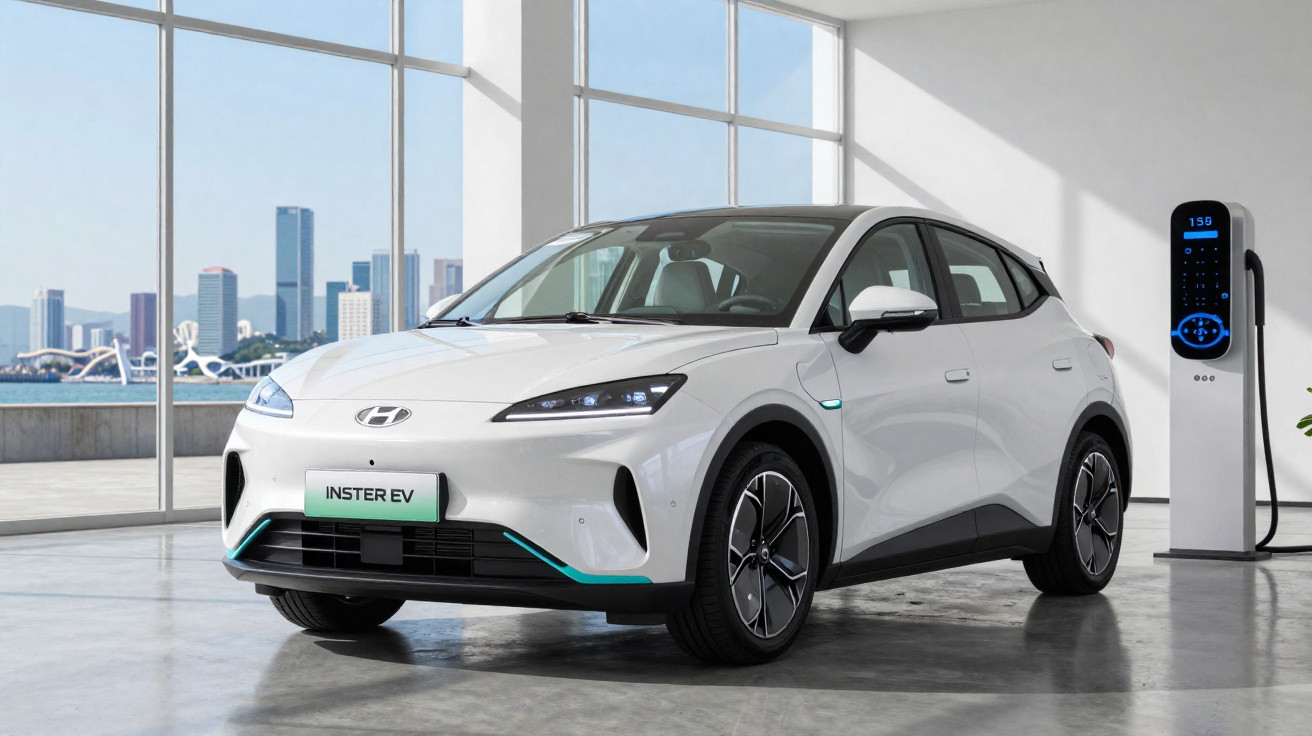
Unveiled at the Busan International Mobility Show in South Korea, the new Hyundai Inster is a 100% electric take on the Hyundai Casper - a “mini SUV” with an internal-combustion engine that was introduced in 2021 but is not sold in Europe.
From the outside, the family resemblance to one of the world’s smallest SUVs is immediately clear, with the same chunky styling and circular LED daytime running lights. Dimensionally, the differences are also fairly minor.
Even so, the new Inster is positioned as a serious proposition for city driving. It is 23.5 cm longer (3.825 m) and only 2 cm wider, at 1.61 m. Height is virtually unchanged compared with the Casper, at 1.575 m, while the wheelbase measures 2.58 m.
Until now, there had been little clarity around the small Inster’s powertrain, but at the Busan event “almost” everything was disclosed.
In entry-level form, the Hyundai Inster uses a 71.1 kW (97 hp) electric motor paired with a 42 kWh battery.
Alternatively, a Long Range version will be offered with a 49 kWh battery. In this specification, output rises to 84.5 kW (115 hp), enough to take the Inster up to 150 km/h.
Both versions deliver 147 Nm of torque. However, where the first completes the 0–100 km/h sprint in 11.7 s, the second needs just 10.6 s.
Range and charging
In Long Range guise, the Inster offers around 355 km of range (WLTP cycle) and an official consumption figure of 15.3 kWh/100 km (WLTP cycle). In the base version, maximum range will not drop below 300 km.
For charging, both variants include an 11 kW AC (alternating current) onboard charger, as well as DC (direct current) charging that can be used up to a maximum of 120 kW. On AC, a full charge takes 4 h 35 min. With a fast charger (DC), it takes just 30 min to move from 10% to 80% battery.
Very small, but very well equipped
Despite its compact exterior footprint, the Hyundai Inster’s cabin is set to surprise, both in terms of technology and day-to-day flexibility.
To start with, there are two 10.25-inch displays - one for the instrument cluster and another for the infotainment system. Navigation is included, along with wireless smartphone charging and the option to use your phone as the car’s “key”.
In addition, the Hyundai Inster comes with a range of features integrated into its Advanced Driver Assistance System (ADAS), including a 360º camera, parking collision-avoidance assist, a blind-spot detection camera, and several others.
Although it seats a maximum of four people, all four seats can be folded down, leaving almost the entire cabin with a flat floor. The individual rear seats also slide fore and aft, allowing boot capacity to be adjusted between 280 and 351 litres.
When will the Inster arrive?
The Hyundai Inster will go on sale in South Korea this summer, with a promise that it will later reach Europe, the Middle East and the Asia-Pacific region. For that reason, it is still far too early to talk about pricing.
What is already confirmed, however, is that Hyundai will launch a second Inster version called Cross, featuring an even tougher, more adventure-focused look.

Comments
No comments yet. Be the first to comment!
Leave a Comment