
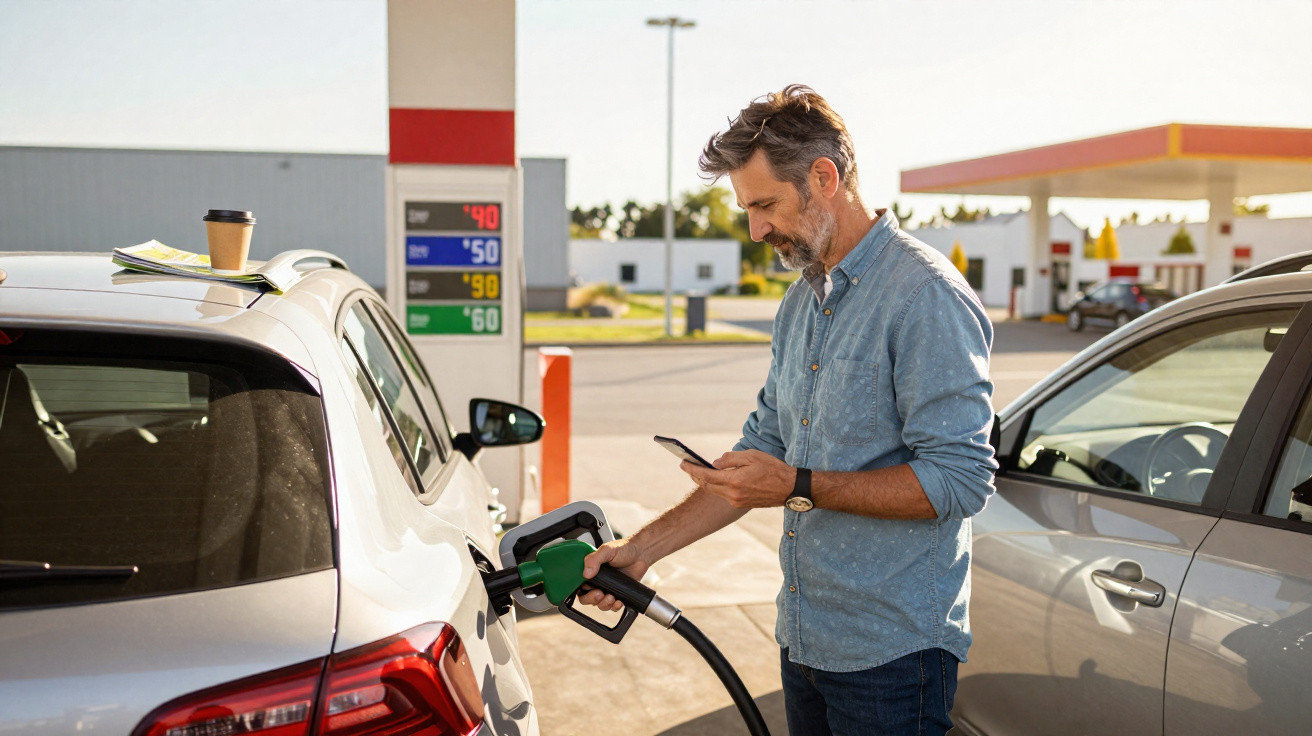
Motorists throughout Europe have been battling high pump prices for a long time, and plenty feel there’s little they can do about it. However, the way German drivers manage refuelling on longer runs shows that a few small, well-timed decisions about where and when to stop can reduce the bill far more than many expect.
Why German drivers rarely fill up on the motorway
Germany’s influential motorists’ association, the ADAC, has monitored fuel prices for years, and its figures underline a familiar reality for anyone who covers big distances.
Service stations directly on motorways tend to charge sharply higher prices than stations just a few kilometres away on local roads.
The ADAC says the difference at German motorway service areas can be as much as the equivalent of €0.40 per litre compared with stations away from the motorway in less “strategic” spots. That quickly adds up:
- With a 40-litre fill, a €0.40 per litre gap works out at €16 more for the very same amount of fuel.
- With a 60-litre SUV tank, you are spending €24 extra every time you refuel on the motorway.
The reason is straightforward. Once you’re committed to the motorway, your choices narrow. On a long journey, many drivers reach a low fuel level and don’t have much room for detours. Fuel retailers are aware of this. With customers who are almost captive and with little immediate competition, motorway stations can hold prices well above the surrounding regional average.
Move away from the main route and the picture changes. Stations in town centres, supermarket forecourts, and on industrial estates often sit close to rivals just along the road. That head-to-head competition pushes prices back towards normal market levels.
On long trips, the “last-minute” stop at a motorway station is often the most expensive decision of the journey.
The German trick: planning your refuelling like a pro
At the heart of the “German-style” method isn’t crawling along at 50 mph in the slow lane or cancelling journeys altogether. It’s about being organised and planning ahead.
Use price-comparison apps before you set off
Across Europe - as well as in the UK and US - fuel price-comparison apps are now common kit for drivers watching the pennies. Many combine crowdsourced reports with retailer data to display live prices on a map.
To get real value from them, check your route before leaving and pick two or three sensible candidates close to your path, rather than waiting until the low-fuel warning light comes on.
- Find lower-priced stations just off the motorway or interstate.
- Confirm opening hours and which payment methods are accepted.
- Aim to stop while you still have a safe reserve, so you can bypass an expensive station if circumstances change.
These modest steps reflect how many German motorists approach long trips, particularly during holiday periods. Rather than “stopping where it’s convenient”, they stop where it makes financial sense.
City and industrial zones: where competition bites hardest
Pricing data across several European markets - including Germany, France and the UK - show a consistent pattern: stations in built-up urban areas or near business parks frequently undercut motorway sites.
Where several brands share the same roundabout, pump prices often fall as each station tries to win a share of local traffic.
In practical terms, a brief diversion towards a nearby town or commercial area can knock several pence or cents off each litre. The time penalty is often small: a five-minute hop off the slip road, a quick top-up, then back onto the main route.
Over time, the biggest gains tend to go to commuters and frequent travellers. A driver covering 20,000 km a year who saves even €0.10 per litre through smarter station selection could recover hundreds of euros over the year.
Timing your fill-up: why the day of the week matters
Price differences aren’t only about location; they also follow weekly rhythms. In Germany, the ADAC and other trackers have long highlighted weekly price cycles, and comparable patterns are increasingly visible elsewhere.
| Day of week | Typical price trend (average pattern) |
|---|---|
| Monday–Wednesday | Often lower prices, especially mornings |
| Thursday–Friday | Gradual increase ahead of weekend traffic |
| Saturday–Sunday | Generally higher, particularly on motorways |
Retailers move prices in line with demand. As people get ready for weekend travel, many fill up from Friday afternoon onwards. Stations react by edging prices upwards, especially on major routes and in holiday hotspots.
Filling up early in the week, when demand softens, often shaves a few cents per litre off the bill.
This isn’t a fixed rule, and it can change with oil price movements or tax adjustments. Still, for plenty of drivers, shifting the main refuelling stop from Saturday to Tuesday can produce savings with no change to how they drive.
Does refuelling in the morning really help?
Another popular tip focuses on the coolest part of the day. The argument is based on physics: fuel expands slightly as temperatures rise, meaning it is a touch denser when it’s colder.
In principle, buying fuel early, when tanks and pipework are cooler, could deliver marginally more energy per litre than purchasing during the hottest part of the afternoon. The effect is real, but underground storage tends to keep fuel temperatures fairly stable, so in many climates the benefit is limited.
Morning refuelling might offer a marginal advantage, but the main savings usually come from station choice and timing across the week.
For anyone who can fill up near home before work, it can still be worth pairing this habit with early-week stops and carefully selected stations. Small percentage improvements add up when combined with the larger, structural differences between expensive and competitive locations.
Building a simple “low-cost fuel” routine
The point where German-style discipline really pays is turning these individual tactics into a repeatable routine. With small tweaks for local conditions, the same approach can work across Europe and North America.
A practical routine for everyday drivers
- When travelling, keep at least a quarter of a tank, so you’re not pushed into the nearest, most expensive forecourt.
- Once a week, use an app to identify stations that are consistently cheaper along your usual routes.
- Arrange refuelling for early in the week, ideally on Monday or Tuesday mornings.
- Favour stations in town centres, supermarket forecourts, or business districts where there’s direct competition.
- For holiday journeys, plan one off-motorway stop in advance, near a town slightly before or after the halfway point.
None of this requires major lifestyle upheaval. It’s about information and timing rather than sacrifice. Over a year, it can bring your average price per litre down by several percentage points compared with a driver who always stops at the first motorway service area.
Beyond the pump: other levers to cut your fuel bill
The German emphasis on planning also fits neatly with wider ways to use less fuel. Pump prices interact with engine efficiency, tyre pressures and driving habits.
Straightforward behaviour changes can help: accelerate more smoothly, keep tyres correctly inflated, remove unnecessary weight from the boot, and ease off sustained high-speed cruising. When you combine lower consumption with cheaper fuel bought through smarter refuelling, you improve both sides of the equation: the price per litre and the litres burned.
Some motorists now do informal “before and after” checks using trip-computer readings. They note average consumption on a familiar route with their normal approach, then repeat it with gentler acceleration and tighter speed discipline. When they also compare receipts from a cheaper, pre-planned refuelling stop, the savings look tangible rather than hypothetical.
There are compromises. Detouring to a lower-priced station costs a little extra time and fuel. And chasing the absolute lowest price across a wide area may not pay if you drive many extra miles to get it. The “German-style” approach isn’t about hunting every last penny; it’s about reliable patterns: avoiding near-monopoly locations, anticipating weekly cycles, and keeping enough fuel in the tank to preserve choice.
As governments push cleaner transport and households adapt to tighter budgets, many drivers are rethinking how they refuel. Planning a stop with the same care as booking accommodation or checking traffic forecasts is increasingly central to everyday motoring across Europe. The German method underlines that a refuelling stop isn’t simply a pause in the journey - it’s a financial decision that repeats week after week.





Comments
No comments yet. Be the first to comment!
Leave a Comment