
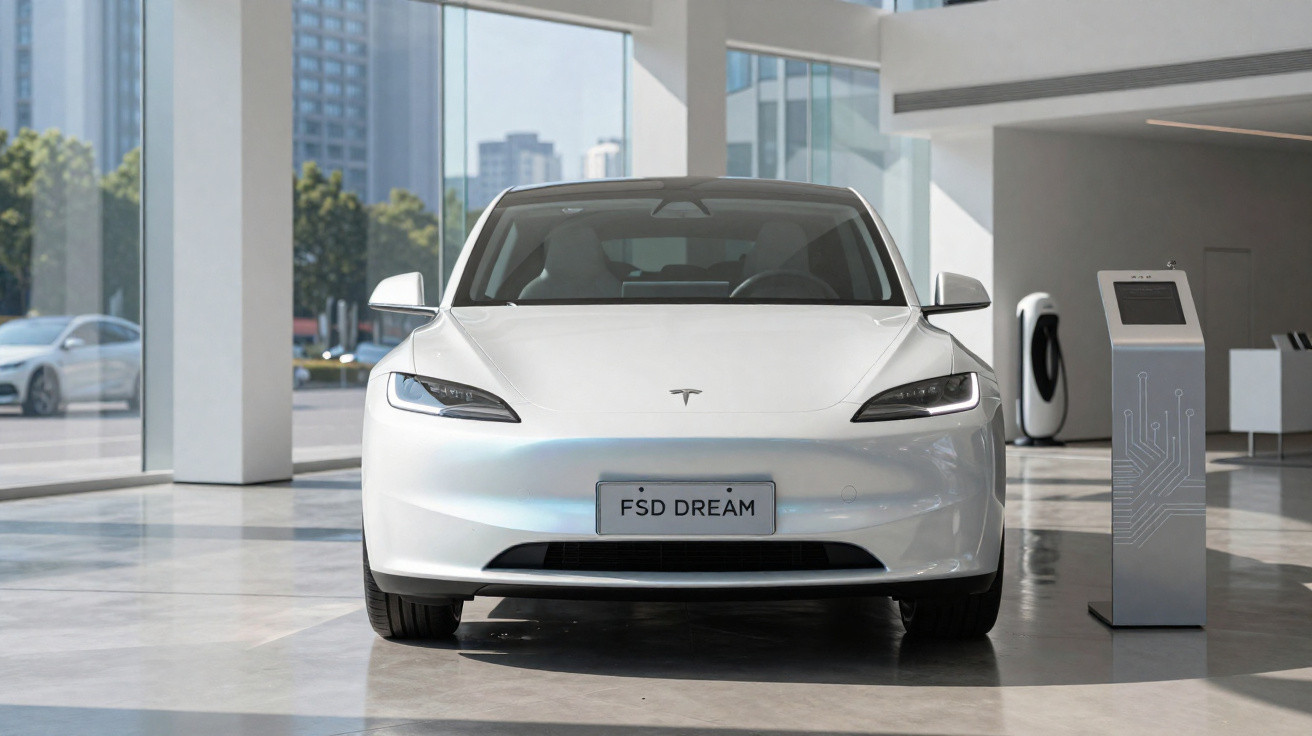
Elon Musk now says that delivering on the promise will come at a cost.
After years of scepticism from critics, the billionaire has at last acknowledged a point they have made for nearly a decade: today’s Teslas are not genuinely self-driving. Turning that long-sold vision into something real will mean costly, disruptive hardware changes that many early buyers never anticipated.
Musk’s long‑delayed reality check
On a late-January 2025 earnings call with key shareholders, Musk dropped a statement many analysts had been expecting. Vehicles fitted with Tesla’s “Hardware 3” computer will not be able to run the company’s next-generation Full Self-Driving (FSD) software unless they receive a physical retrofit.
“I think the most honest answer is that we’re going to have to upgrade the Hardware 3 computer of people who bought Full Self-Driving. It will be painful and difficult, but we’re going to do it.”
That remark cuts against almost a decade of unwavering forecasts. Musk repeatedly insisted that every Tesla sold since the mid‑2010s already contained all the hardware required for full autonomy, with software as the only missing piece. In the United States, customers paid as much as $12,000 for the FSD option, believing Tesla would eventually “unlock” true self-driving via over‑the‑air updates.
Instead, many now face service bookings, computer replacements and renewed uncertainty about what, precisely, their money has bought.
A decade of shifting timelines
Musk’s schedule for self-driving has shifted so frequently it became a long-running industry punchline. Year after year, fully autonomous driving was presented as imminent: always months away, never years.
The thread begins in 2016, when Tesla claimed every new car leaving the factory came with the hardware needed for “full self-driving capability”. The message focused on future-proofing: buy now, and a later software update would enable the car to drive itself.
Over time, that sales pitch moved through multiple hardware iterations:
- Hardware 2.0 / 2.5: Brought more capable driver-assistance sensors and increased computing performance.
- Hardware 3: Introduced in 2019 and promoted as the real “Full Self-Driving computer”.
- Hardware 4: Currently shipping on new models and advertised as the next major step towards autonomy.
When Hardware 3 arrived, many owners of Hardware 2.0 and 2.5 vehicles learned they would need a new computer to access the promised FSD improvements. That helped trigger legal complaints, claims of misleading marketing and class-action lawsuits in several regions.
The latest acknowledgement indicates Hardware 3 may also have been oversold. Once again, Tesla is confronted with a gap between what buyers were led to expect and what the newest software appears to demand.
A costly promise comes due
The financial implications could be substantial. Globally, hundreds of thousands of Tesla owners paid for FSD years ago. If Tesla genuinely plans to replace the computer in every Hardware 3 vehicle that has FSD, the cost could run into hundreds of millions of dollars, even before labour and logistical expense are included.
Tesla now stands trapped between its marketing story and the engineering reality: either pay to upgrade cars, or admit that earlier promises overstated what customers would receive.
On the call, Musk framed the retrofits as an ethical duty to existing FSD purchasers. At the same time, he described the process as “painful and difficult”, signalling how much upheaval Tesla expects. The company already operates a tightly stretched service network; large-scale retrofits could overload workshops, extend waiting times and aggravate customers who feel they have already paid once.
What this means for current Tesla owners
Owners broadly fall into a few groups, each with different implications. In simplified form:
| Owner type | Hardware | Paid for FSD? | Likely outcome |
|---|---|---|---|
| Early adopters (pre‑2019) | HW 2.0 / 2.5 | Some yes, some no | Many already upgraded once to HW3; unclear path to next‑gen FSD. |
| 2019–2023 buyers | HW 3 | Large share paid FSD or subscription | Now told they will need another computer upgrade for full capability. |
| Recent buyers | HW 4 | FSD still sold, but not fully delivered | Waiting for software that truly uses the new hardware. |
For customers who paid thousands up front for FSD, there is a difficult choice. They can wait for Tesla to design, organise and roll out the upgrade programme, or they can accept that their car may never align with the original marketing message. Some are likely to seek refunds, particularly in markets where consumer-protection authorities already scrutinise Tesla’s claims around autonomy.
Legal and regulatory pressure grows
Authorities in the United States, Europe and Asia have monitored Tesla’s wording around “Autopilot” and “Full Self-Driving” for years. Safety bodies have repeatedly warned motorists not to treat these systems as autonomous, while Tesla’s branding and Musk’s public remarks often implied that genuine self-driving was close.
Earlier cases centred on “false advertising” tied to Hardware 2.x and Hardware 3 upgrade requirements may now gather new momentum. Consumer lawyers can point to Musk’s recent statement as clear evidence that past promises did not match the technical reality at the time.
Once a CEO publicly acknowledges that a product cannot meet its advertised capabilities without costly retrofits, legal arguments about misleading claims gain far more traction.
For Tesla, that exposure sits alongside existing investigations into collisions involving Autopilot and FSD Beta. Even if the company prevails in many disputes, ongoing legal uncertainty consumes leadership focus and may push Tesla towards more restrained language in future announcements.
Competition catches up in the robotaxi race
As Tesla circles back to earlier commitments, competitors continue to develop alternative strategies. Established carmakers and technology firms often favour combinations of lidar, radar and high-definition mapping, supported by high-performance onboard computing. Tesla, in contrast, has famously put its faith largely in cameras and neural networks.
In certain cities, robotaxi services run by other companies already operate on a limited commercial basis with human oversight. They remain small in scale, but they illustrate a route where tightly supervised autonomy could expand area by area, rather than arriving through one global software switch.
Tesla still has strengths: a huge installed fleet, extensive driving data and closely integrated software. However, repeated redefinition of what FSD can do erodes confidence at the very moment regulators and city authorities are deciding which platforms they trust for large-scale autonomous deployment.
Why hardware keeps changing in a “software‑defined car”
Musk’s underlying promise has been simple: “All the hardware you need is already in the car.” Recent years show how difficult it is to uphold that claim in a fast-moving AI landscape.
Developing and running sophisticated neural networks requires vast computing resources. As Tesla’s AI teams pursue “end‑to‑end” approaches that convert raw camera video into driving actions directly, they push older computers to their limits. A chip that looked formidable in 2019 can seem comparatively modest by 2025.
That relentless progress creates friction between engineering and marketing. Engineers want spare capacity for future capability. Marketing prefers sweeping assurances that reassure buyers their vehicle will not date quickly. The FSD story demonstrates what can happen when those priorities drift too far apart.
Practical lessons for tech buyers
Tesla’s situation highlights several practical points for anyone spending money on high-tech products that rely on future upgrades:
- Treat schedules that slip “just one more year” with caution.
- Focus on what features exist now, not only what is promised later.
- Confirm whether regulators classify a system as driver assistance or true autonomy.
- Consider subscriptions rather than large one-off payments for features that are not yet proven.
Autonomous driving is likely to emerge in uneven phases, with certain cities and particular motorways supporting more advanced systems than others. A car purchased today may gain impressive new functions over time, but it may also reach a hard limit when rising software ambition runs into fixed hardware constraints.
For Tesla, Musk admitting that “it will be painful and difficult” is an unusually candid moment on autonomy. For owners who paid thousands for FSD years ago, the real proving ground is now: not slogans or staged demonstrations, but whether Tesla quietly and reliably upgrades their cars to something closer to what they believed they were buying.
Comments
No comments yet. Be the first to comment!
Leave a Comment