
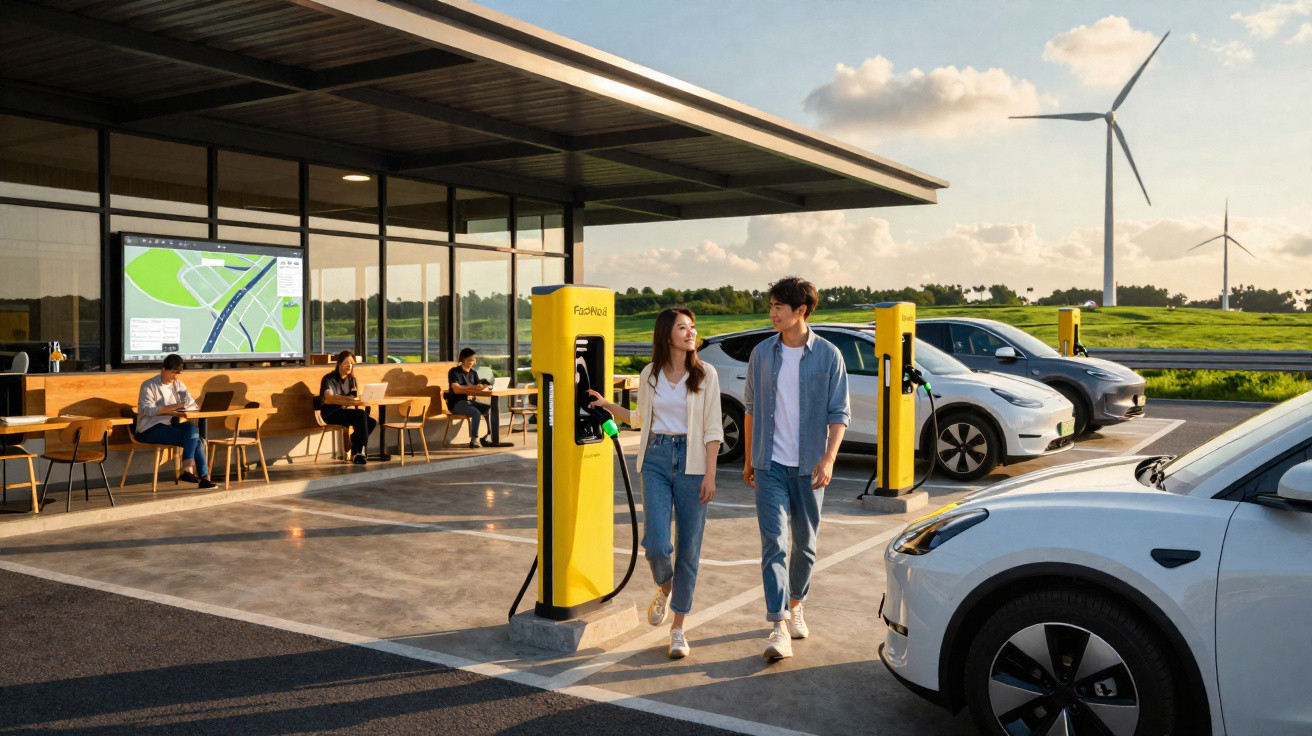
On a heavily trafficked stretch of road in western France, a long-standing roadside habit is set to shift in a way motorists will notice immediately.
What might appear to be an ordinary rest-area build in Brittany is, in fact, a deliberate move away from pumps, fumes and the old assumptions of long-distance travel. A Dutch charging operator is preparing to use a French national route as a real-world demonstration of what a service area looks like after petrol.
A French highway stop with no fuel pumps at all
On the RN165 - the key link between Nantes and Brest - a new stop at Saint-Yvi in Finistère is due to become France’s first service area devoted solely to electric charging. The western regional roads authority (DIR Ouest) has selected the Dutch firm Fastned to design and run the facility.
This portion of the RN165 carries more than 28,000 vehicles each day. Historically, traffic levels like that have meant the familiar set-up: several fuel pumps, a shop, and a broad forecourt where petrol and diesel define the scene. Saint-Yvi is intended to do the opposite.
"This will be the first French highway-style service area where drivers can stop, rest and recharge without a single fossil fuel pump on site."
At launch, the location is set to offer six ultra-rapid charging points for electric vehicles, including a 400 kW charger aimed at heavy lorries and coaches. At that power level, compatible HGVs can add meaningful range during a legally required rest period - a practical consideration as freight firms assess what it costs to move away from diesel.
Fastned’s bet on the next normal of road travel
Fastned, established in the Netherlands, has spent roughly the last ten years rolling out its bright yellow, ultra-rapid charging hubs across Europe. It now runs more than 380 stations, with over 50 of them in France, typically working alongside motorway companies or public bodies.
Saint-Yvi is positioned as a step beyond simply bolting chargers onto an existing petrol forecourt. Here, electricity dictates the layout from the outset. For Fastned, the symbolism is clear: EV charging is not being tucked away as an add-on; it is the core service.
"The site becomes a proof of concept for a network where drivers no longer view electric charging as an exception, but as the default service model."
DIR Ouest’s tender places emphasis on both output and comfort for users, and Fastned’s approach follows that direction. The operator’s stations are commonly built with wide canopies, straightforward circulation, strong lighting and easy-to-read pricing - closer in atmosphere to a modern airport drop-off than a cramped charger squeezed behind a supermarket.
Opening in 2026, with more than just fast plugs
Work at Saint-Yvi is due to begin at the start of next year, with the site scheduled to open in 2026. That timetable matches France’s wider drive to expand to hundreds of thousands of public chargepoints by the middle of the decade, supporting a rising number of electric cars, vans and buses.
Although the defining feature is charging capacity, the wider stop is designed to feel familiar rather than alien to passing drivers. Plans include:
- a convenience shop selling drinks, snacks and basic travel essentials
- modern, accessible toilets
- a landscaped garden intended as a calm pause away from traffic
- photovoltaic canopies that provide shelter and generate local solar electricity
- planting with native species to help the site sit naturally within the Breton landscape
Under Fastned’s standard operating model, the station’s electricity will be sourced entirely from renewables. The company typically procures green power from wind and solar, while roof-mounted PV can help shave peak demand on the grid when conditions are sunny.
Why a fuel-free site matters more than one might think
Seen from afar, swapping pumps for chargepoints can look like a superficial change. In reality, several fundamentals shift at the same time:
| Aspect | Traditional service area | Saint-Yvi electric area |
|---|---|---|
| Energy on site | Petrol, diesel, some EV chargers | Only electricity, powered by renewables |
| Design focus | Fuel throughput, car parking secondary | Driver rest and charging time experience |
| Pollution | Tailpipe fumes, fuel deliveries, spills risk | No fuel handling, lower local emissions |
| Heavy vehicle support | Diesel trucks dominate | High-power truck charger encourages e-freight |
Eliminating petrol and diesel altogether also means combustion vehicles cannot use the stop to refuel mid-journey. From a policy angle, that functions as a gentle steer. For operators planning routes, however, it becomes a fixed reference point for electric lorries and coaches - and a sign that these vehicles are being catered for deliberately rather than as an afterthought.
A European pattern: after Belgium, now France
The Saint-Yvi build comes after Fastned’s September opening of what it called Europe’s first 100% electric motorway service area, launched at Gentbrugge in Belgium. As in Brittany, the Belgian site is located directly on a high-traffic motorway corridor rather than tucked away on an industrial estate away from long-distance flows.
Across both projects, Fastned highlights its “nature-inspired” design language, using yellow steel arches and broad glass canopies that bring in daylight while keeping vehicles out of the rain. The look strengthens brand recognition, but it also communicates permanence: this is infrastructure intended to last, not a temporary workaround.
"By repeating the formula across borders, Fastned turns these sites into a sort of familiar living room for EV drivers on long trips through Western Europe."
In France - already home to major Tesla Superchargers routes and multi-brand hubs operated by oil companies - a dedicated electric-only service area adds another competitive model. Ultimately, the factors that will shape what drivers on the RN165 choose are price, reliability and the quality of the facilities.
What this means for drivers planning long trips
For an EV motorist travelling towards Quimper in a few years’ time, Saint-Yvi is meant to enable a simple stop: plug in, visit the toilets, pick up a coffee, stretch in the garden, then return to a car that has added enough range in 10 to 20 minutes to continue.
Because the design is built around high-power charging, older or smaller EVs will not always reach the headline speeds. Even so, they still gain from a site planned for turnover, clear entry and exit routes, and proper waiting space. The aim is to avoid the familiar frustrations of reversing into a tight corner behind a petrol pump or queuing for a lone slow charger by the bins.
The inclusion of a 400 kW lorry charger also points to a second group of users: hauliers pushed by regulation and customers to reduce emissions. If drivers can consistently add several hundred kilometres of range during a mandatory break, range anxiety becomes less of a barrier for electric trucks on at least some regional runs.
Risks and challenges behind the optimistic renderings
Schemes like this rarely arrive without complications. Several uncertainties sit behind the Saint-Yvi showcase.
- Grid capacity: six high-power units, including one rated at 400 kW, could draw multiple megawatts at peak. Whether holiday weekend queues stay under control will depend on local network upgrades and intelligent load management.
- Pricing pressure: ultra-rapid public charging still costs more per kWh than charging at home or at work. If prices climb too far, some motorists may continue to divert off-route for slower but cheaper alternatives.
- Acceptance by combustion drivers: by 2026, many vehicles on the RN165 will still use petrol or diesel. Those drivers may regard the space as poorly used if they cannot refuel there - at least until more mixed-fuel sites appear close by.
- Seasonal peaks: Brittany experiences sharp spikes in summer traffic. The stop will need to handle waves of EVs, family SUVs and caravans, not only routine weekday demand.
Public authorities and the operator are likely to treat Saint-Yvi as a practical learning site. Observations such as demand patterns, average charging duration, queuing behaviour and even how long visitors spend in the garden can shape how future French locations are designed.
Broader context: service areas as climate infrastructure
On its own, a station with six chargers may not sound like a major climate-policy milestone. Scaled across hundreds of similar sites, however, it becomes part of a network that either accelerates or slows the shift towards lower-emission vehicles.
A number of European states now integrate the electrification of service areas into their national climate and transport plans. Motorway routes are expected to offer fast charging at regular spacing, while grants and tenders incentivise private firms to build and operate the infrastructure. That public–private approach sits behind Fastned’s agreement with DIR Ouest.
France’s example reflects a subtle change in thinking: rather than asking how EVs can be squeezed into petrol-era stops, planners are now designing entire sites around electric drivetrains. That means considering power electronics, grid connections, solar canopy orientation, digital payment, and even the reduced noise for nearby residents when idling engines disappear.
For motorists, the transition may begin as just another pin on a route planner. Over time, as more locations adopt the Saint-Yvi template, long journeys are likely to be organised around where fast, comfortable charging is available - rather than around where diesel happens to be cheapest.
What to watch next
A few indicators will reveal whether Saint-Yvi becomes a genuine turning point or simply a well-photographed trial.
- The volume of comparable tenders issued by other regional road authorities in France.
- The speed at which lorry fleets make the stop part of regular schedules.
- Whether nearby businesses (restaurants, hotels and logistics parks) pivot to serve charging breaks rather than refuelling stops.
For now, the project captures a quiet but telling shift: on a busy route to the far west of France, construction teams will build a service area where the smell of fuel is absent, and where energy arrives mainly through cables and sunlight rather than tanker deliveries.



Comments
No comments yet. Be the first to comment!
Leave a Comment