
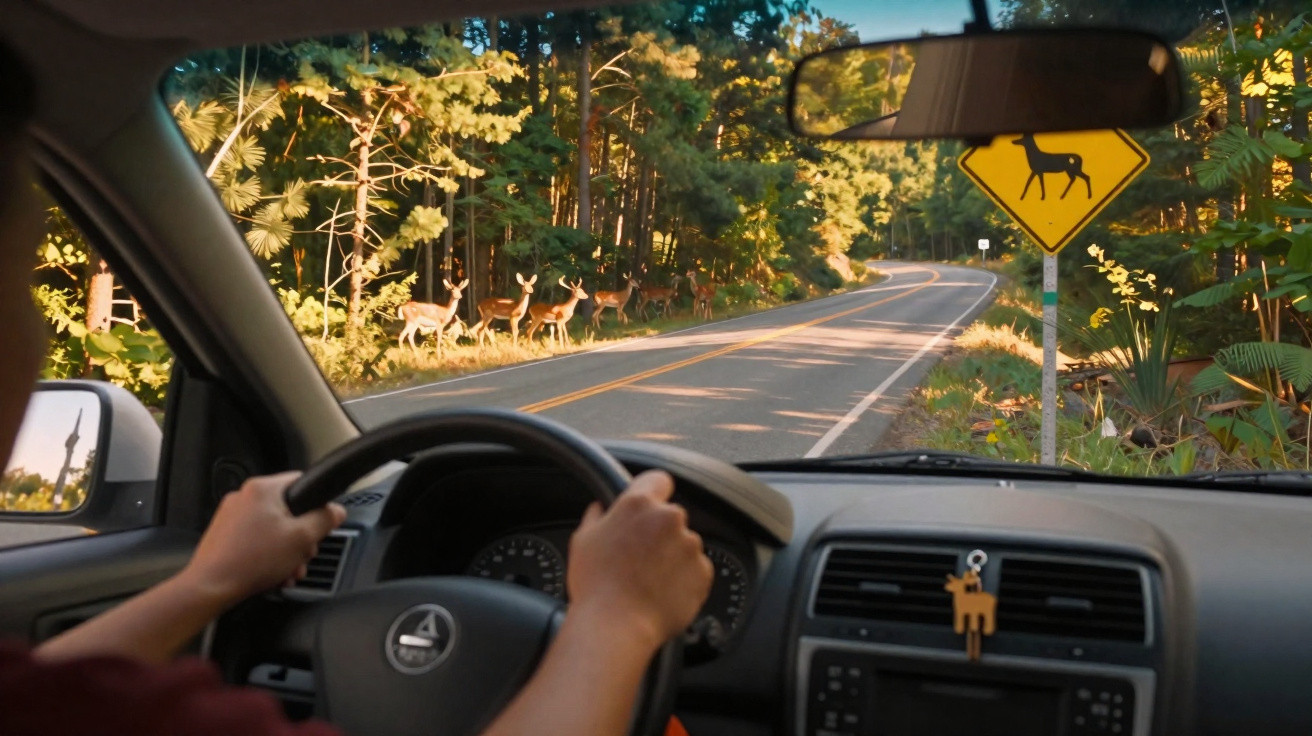
The first time I properly clocked the sign, I was waiting at a red light outside a supermarket, late-afternoon sun flashing off a queue of windscreens. A yellow triangle, red border, a black deer mid-leap. I’d passed it countless times without giving it a second thought. In the car beside me, a driver tapped his fingers on the steering wheel, eyes dull, half-following a podcast. To the right, the woodland shifted gently in the breeze. Nobody eased off. The lights changed, and we all surged ahead as though the sign were nothing more than roadside wallpaper.
A few hundred metres on, a young roe deer stood rigid in the ditch, less than a metre from the tarmac.
You know that sign. You probably interpret it wrong.
The sign we think we understand… but don’t
Most of us treat the leaping deer sign like a small nod to the countryside: a pleasant symbol, a broad “just in case” warning. Somewhere nearby-perhaps a kilometre away-there could be an animal. So we carry on at the same pace. At most, we tighten our grip for a moment. Because the icon is so familiar, the brain files it as “scenery” rather than “threat”.
But the animal warning sign isn’t saying, “Wildlife exists in this area.” It’s saying, “This precise stretch of road is a live crossing point-right now-whether you spot anything or not.”
Speak to a recovery driver or a firefighter who covers rural calls and you’ll hear the same pattern. A night-time job. A slick road. A small hatchback in the ditch, bonnet crumpled, airbags deployed, the driver trembling and dusted with glass. Cause: “a deer that came out of nowhere”. Except it didn’t. The driver had gone past three animal warning signs in the previous five kilometres.
In Germany, police log more than 200,000 collisions with wild animals each year. In the US, State Farm puts the figure at around 1.8 million animal-related crashes annually-mostly involving deer. All the while, those bright yellow or red-edged signs were there in plain view, repeatedly dismissed by drivers who assumed they already “knew” what they meant.
The mind is good at deleting repeated cues. When you drive the same route daily, you slip into a kind of mental autopilot. Traffic lights, roundabouts and speed bumps still cut through because they demand an action. The deer sign doesn’t. There’s no alert tone, no camera, no fine-so it gets relegated to the background.
Even the graphic works against us. A clean, stylised deer in a graceful jump doesn’t convey the brutal reality of a 90 km/h impact: the crack of the windscreen, the jolt, the animal sliding across the bonnet. The sign is accurate; our reading of it is too gentle. We take it to mean “be cautious at some point”, when it should mean “drive differently for the next few minutes”.
How you’re actually supposed to react when you see it
Road safety specialists aren’t asking you merely to register the deer sign. They’re looking for a deliberate set of steps over the next 300–500 metres. Start by easing off the accelerator. A reduction from 90 to 70 km/h massively reduces stopping distance-and the force of any collision. Then broaden your attention beyond the lane ahead. Watch the margins: ditches, field boundaries, gaps in hedgerows-those are the places movement first shows.
If it’s dawn, dusk or night-time, you need to treat the same sign with extra seriousness. That’s when deer, boar and moose are most active. Use short sweeps of light from verge to verge. Scan for two small reflections close to the ground: eyes. That faint glimmer may be the only warning you receive.
This is where many of us slip up, and not because we’re deliberately careless. We’re fatigued, thinking about dinner, running late, managing children arguing in the back seat. We reassure ourselves, “I’ll slow down if I actually see something.” The trouble is that by the time you do “actually see something”, it can already be too late.
Another common error is swerving. You catch a shape, you snatch the wheel, and you drift across the centre line. Head-on crashes kill more people than direct impacts with animals. Let’s be honest: nobody really practices what they would do in that split second. But rehearsing the right reflex-just a little, in your head-can be the difference-maker on a dark, empty country road.
Road safety officer Marta Silva summed it up to me in a parking lot after a training session: “People think the sign warns about deer. It doesn’t. It warns about themselves. About how fast they’re going, about how narrow their attention has become.” Her words linger every time I hit a dark stretch with trees.
- Reduce speed by at least 10–20 km/h after every animal warning sign on rural or wooded roads.
- Move your gaze outward: check verges, fences and field edges for motion or eye-shine.
- Hold the wheel and pre-plan: if an animal appears, brake hard in a straight line rather than swerving sharply.
- Assume there will be more than one: when a deer or boar crosses, others often follow within seconds.
- At dawn and dusk, treat every animal sign as a “high alert” zone, even on roads you drive every day.
The sign is silent. The stories behind it are not.
Once you start truly noticing that leaping deer, driving feels subtly changed. The road stops being only tarmac and minutes saved; it becomes a passageway cutting through real habitat. Farmers can tell you where herds tend to cross. Hunters recognise the runs. Wildlife officers could point to the exact bend where collisions repeat every autumn.
And you-hands on the wheel-are the last link in that chain. You choose whether that small triangle on a post is just more visual clutter, or a prompt to adjust your behaviour for a few seconds. That minor shift in attention is worth more than any new piece of technology on your dashboard.
| Key point | Detail | Value for the reader |
|---|---|---|
| Animal warning signs mark active crossing zones | They indicate road sections where crashes are common, not a vague “nature nearby” area | Helps you respond early instead of treating the sign as background decoration |
| Speed reduction is your best protection | Cutting 10–20 km/h after the sign reduces stopping distance and impact force | Lowers the chance of serious injury to you and your passengers if an animal appears |
| Swerving is often more deadly than impact | Sudden lane changes can cause head-on crashes or rollovers, especially at night | Gives you a clear mental script: brake firmly, stay straight, stay in control |
FAQ:
- Question 1: Does the animal warning sign mean there are always animals on the road?
- Question 2: Is it safer to swerve than to hit a deer or boar?
- Question 3: What should I do right after I see the sign?
- Question 4: Why are these signs often near forests and fields?
- Question 5: What if I hit an animal despite being careful?



Comments
No comments yet. Be the first to comment!
Leave a Comment