
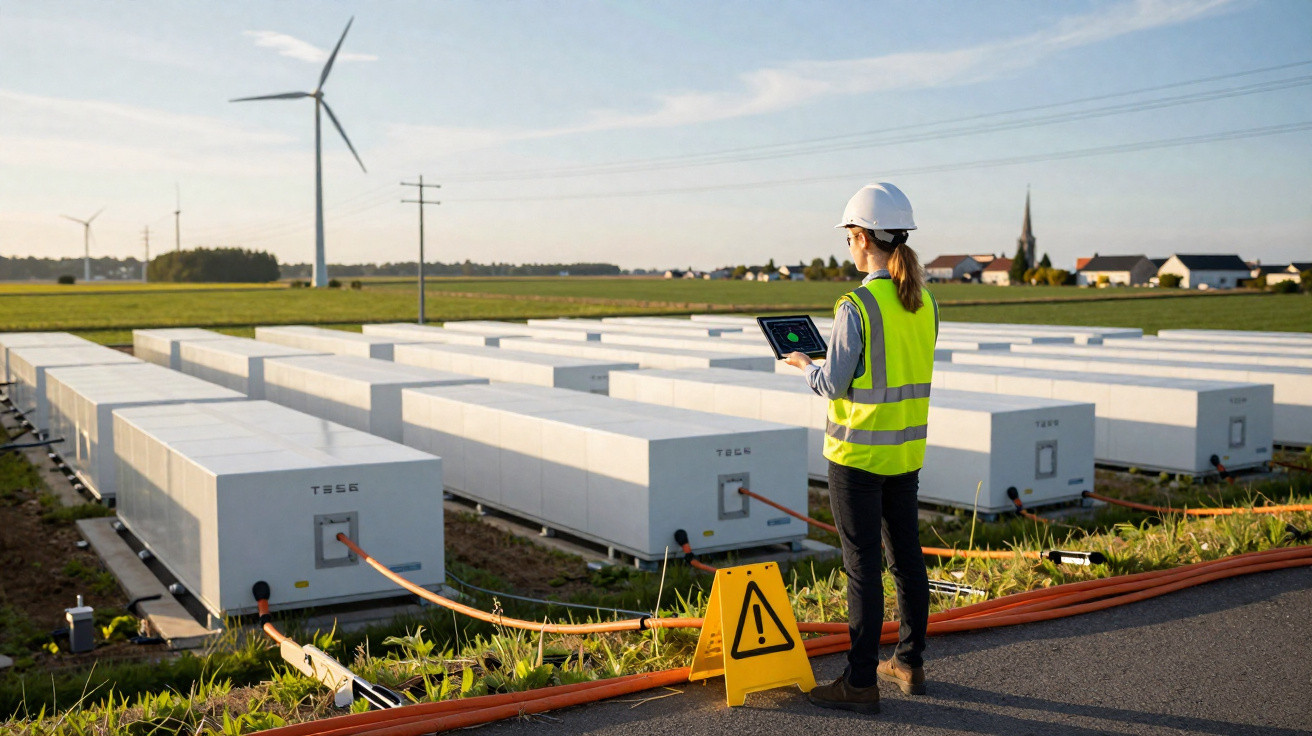
A project now taking shape near the city of Reims is being treated as a proving ground for what comes next in French energy policy. A storage complex built around Tesla Megapacks is intended to start absorbing large volumes of electricity from early 2026, then feed it back into the grid at very short notice when needed. The scheme involves more than the US manufacturer: it is being delivered with an energy developer that wants France to rely far less on fossil fuels.
What Tesla is building near Reims
At the centre of the site is a utility-scale battery energy storage system (BESS). The operator, TagEnergy, is using Tesla’s Megapack - a ready-built, containerised large-scale battery with integrated power electronics.
For the Cernay-lès-Reims location, 140 Megapacks have been ordered. The scale is substantial:
- Power: around 240 megawatts
- Energy capacity: 480 megawatt-hours
- Share of supply: roughly one fifth of the Marne département’s electricity demand for several hours
- Population context: a region with more than 500,000 residents
“The battery near Reims can respond within seconds, balancing fluctuations in the French power grid before consumers notice anything.”
Operationally, that means the Megapacks act as a buffer when output drops suddenly - for instance during a lull in wind, or if generation capacity is unexpectedly lost. In the other direction, they recharge when wind and solar are plentiful and wholesale market prices fall.
Why France is now backing large-scale batteries so heavily
France still draws a high share of its power from nuclear, yet it is also under pressure to ramp up renewables quickly. As more wind and solar connect to the grid, swings in available supply become more pronounced - precisely the problem the Reims-area project is designed to address.
The storage system’s objectives are straightforward:
- stabilising grid frequency at 50 Hertz
- providing power during peak periods, such as winter evenings
- making better use of renewable electricity that might otherwise be curtailed
- reducing expensive imports during tight hours
TagEnergy intends to expand its French solar and battery storage activity significantly from 2025. In that sense, the Reims site is more of a starting point than a one-off. For France’s transmission system operator, projects like this offer a way to make the system more flexible without immediately resorting to building new gas-fired power stations.
Tesla as a quiet power-sector player
Tesla is still widely associated almost exclusively with electric cars. Inside the company, however, energy storage has become a core line of business - covering home batteries such as the Powerwall, but especially grid-scale products like the Megapack.
These units are manufactured in a dedicated Megafactory with an output capacity of about 40 gigawatt-hours of storage per year - enough to supply several dozen projects on the scale of the Reims installation. Demand for such systems is rising sharply, not only across Europe, but also in North America, Australia and Asia.
Tesla is responding by adding a second plant in Shanghai, where Megapacks are also expected to be produced shortly. That gives the group a second pillar alongside vehicle manufacturing - less visible, but highly profitable and politically attractive, as governments worldwide look for sources of flexible capacity.
How the Megapack works
A Megapack is essentially a container packed with lithium-ion cells, combined with inverters, control computers and its own cooling system. Unlike typical home batteries, these units can be charged and discharged rapidly hundreds of times a year without the cells wearing out too quickly.
Control is handled by software that continuously tracks how prices, demand and grid stability are shifting. The operator can choose how assertively to run it: prioritising grid stability, chasing arbitrage profits in the electricity market - or blending the two.
“Large-scale batteries are shifting from pure emergency back-up into trading machines, reacting to price signals and grid fluctuations with millisecond precision.”
What the mega-battery could mean for consumers
For households around Reims, little appears to change at first glance: there is no extra meter, and no new cable run to homes. The impact sits largely in the background.
Possible effects for consumers in the region and nationally include:
- a lower risk of short, sudden outages during periods of constraint
- smoother price spikes on the wholesale market, which could stabilise tariffs over time
- easier integration of new wind and solar parks without overloading the network
- less need to start up costly peak-load plants
For France overall, the storage site strengthens security of supply in a system that has faced tight moments in several recent winters. Grid operators have sometimes had to curtail industrial users to avoid blackouts. Flexible storage can reduce how often such measures are needed.
Risks, limits and open questions
Despite the promise, downsides remain. Utility-scale lithium-ion storage is expensive, even though prices have fallen in recent years. Whether the project pays off financially depends heavily on market conditions - including price volatility, subsidy rules and competition from other flexibility options such as gas plants or demand-side management.
Safety is another point of scrutiny. Battery-storage fires around the world regularly make headlines. Operators point to layered safety designs, automatic shut-down systems and physical separation between containers. Even so, regulators remain cautious, particularly where storage sits close to residential areas.
A further debate centres on raw materials. Lithium, nickel and other metals often come from regions with sensitive ecosystems or problematic labour conditions. Projects like Cernay-lès-Reims therefore also send a signal up the supply chain: the more grid batteries are built, the greater the pressure to extract and recycle these materials more sustainably.
Why the Reims location is strategically significant
The area around Reims sits on an important node in France’s high-voltage network. Electricity from multiple nuclear stations, wind farms and solar sites converges here, alongside heavy demand from industry and logistics.
Placing a large battery at such a point works like a shock absorber: it takes in power when there is too much energy on the lines, and releases it when demand suddenly surges. Grid expansion is still required, but installations like this can improve planning and, in some cases, slow the pace - spreading multi-billion-euro investments over a longer period.
What this step means for Europe’s energy transition
France is not the first country to adopt Tesla Megapacks, but the installation now being built ranks among the largest in Europe. For other states, it serves as a reference case for how storage can be integrated into both market operations and grid-balancing regimes.
From a German perspective, the project is particularly noteworthy: pressure is rising there too to manage large volumes of renewable electricity flexibly. While debate continues about expanding gas-fired generation, more projects like the one near Reims could steer the discussion towards storage that works with existing grids rather than deepening new fossil dependencies.
Terms such as power (in megawatts) and capacity (in megawatt-hours) will keep surfacing in this debate. Power describes how strongly the battery can feed electricity in at any given moment; capacity indicates how long it can sustain that output. The Reims battery combines both at a level sufficient to cushion a sizeable share of an entire region for several hours.
That blend of technical punch and commercial flexibility is what makes the scheme so contentious: if the trial near Reims succeeds, the mega-battery is unlikely to be the last of its kind in France - or, quite possibly, in Europe.



Comments
No comments yet. Be the first to comment!
Leave a Comment