
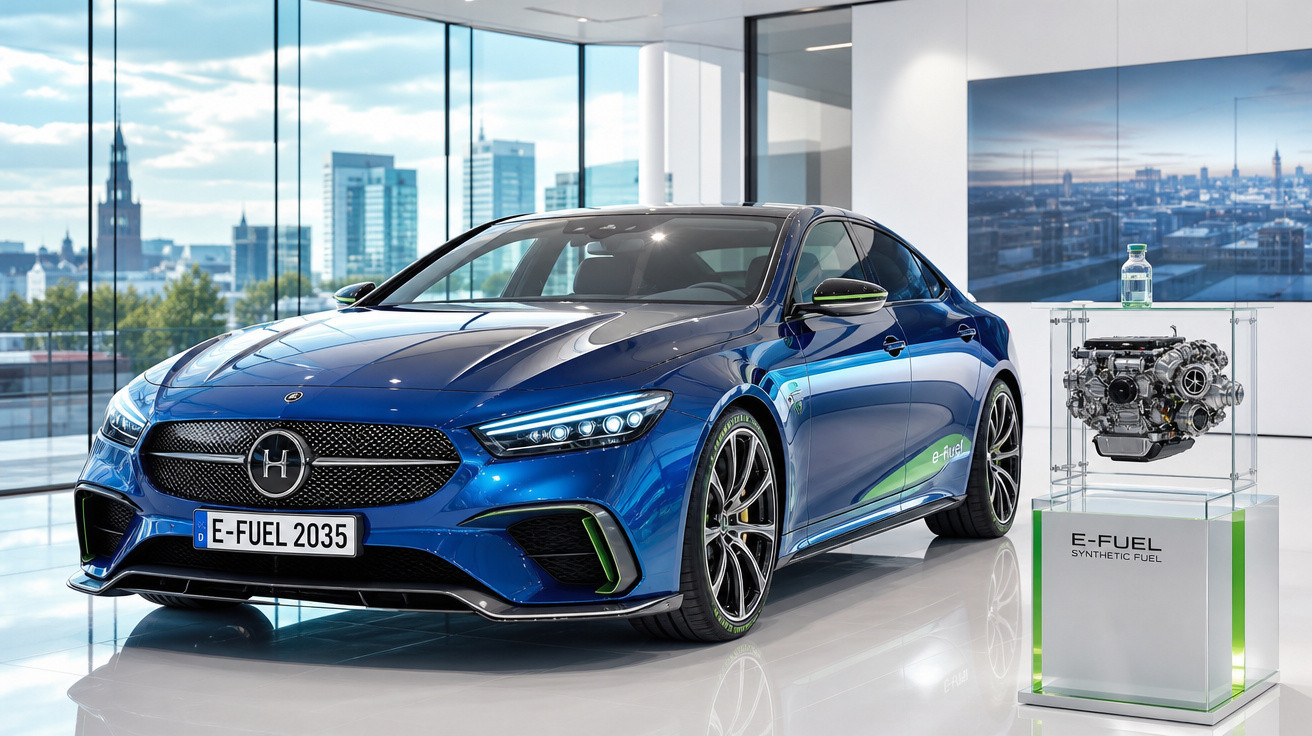
Germany has turned to the European Union in an effort to keep allowing the sale of new cars with internal combustion engines beyond 2035, provided they run on carbon-neutral fuels such as synthetic fuels.
After Italy criticised the European Union’s sole focus on electric vehicles, Germany is also seeking to prevent the complete disappearance of the combustion engine from 2035 onwards. Germany likewise does not want to “close the door” on other technologies in the fight against emissions.
For Michael Theurer, Germany’s Secretary of State for Transport, “the European Commission should present a proposal for the use of synthetic fuels, or on what will happen to combustion engines that can use carbon-neutral fuels”.
Germany has reinforced the message that the future lies in electric vehicles, but Theurer said it would be beneficial to examine other alternatives.
According to the German Secretary of State for Transport, “hydrogen fuel cell technology and synthetic fuels will be necessary, especially in heavy vehicles”.
Synthetic fuels are an alternative
Produced through CO2 (carbon dioxide) capture, which is then combined with green hydrogen (obtained from renewable sources), synthetic fuels and other carbon-neutral fuels have been identified as a route towards decarbonising the transport sector.
It is not yet known whether the German proposal will be accepted, but there are signs suggesting that the combustion engine could survive thanks to carbon-neutral fuels.
At a press conference, the European Union’s Commissioner for Transport, Adina Valean, recalled that many in the transport sector share Germany’s concerns.
She added: “I think the discussion is not closed, even though the vote has taken place”, leaving open the possibility of changes to the rule that technically banned internal combustion engines in the European Union from 2035.
Europe open to reviewing measures
In the same vein, it is worth recalling the recent remarks of Thierry Breton, former French Economy Minister and current European Commissioner for the Internal Market, who has been one of the more cautious voices in Europe regarding the ban on the sale of new cars with combustion engines.
In an interview with the French newspaper Les Echos, the European Commissioner once again stressed the risks that this decision may bring. Among them are a drop in exports, the loss of 600,000 jobs, and higher car costs for Europeans.
Source: Reuters


Comments
No comments yet. Be the first to comment!
Leave a Comment