
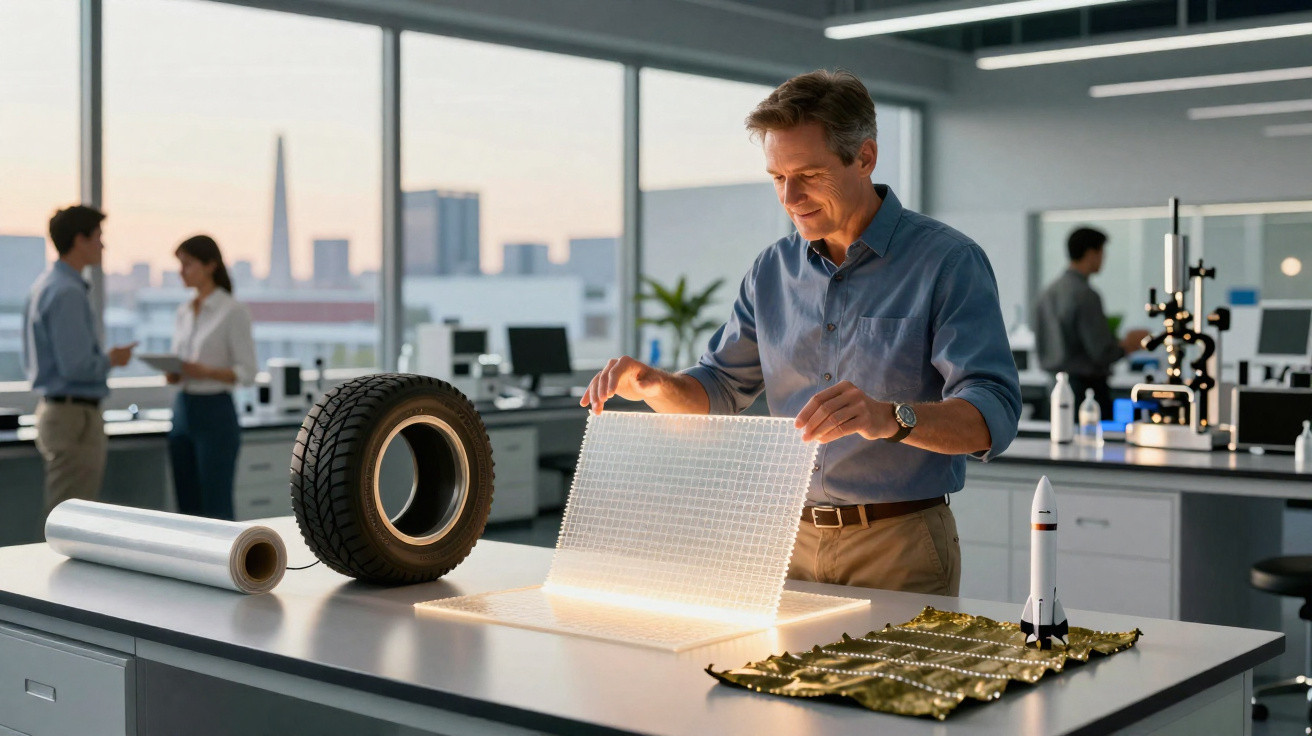
The cheerful white Michelin mascot masks a quieter reality: the group is methodically building a business that has little to do with car tyres.
Already the world’s leading tyre maker, the French company is rapidly expanding into advanced industrial fabrics and high‑performance composites, wagering that the next major source of profit will come from materials that never go near the tarmac.
Michelin’s bold push beyond tyres
Michelin has set out plans to buy two US specialists, Cooley Group and Tex Tech Industries, in transactions that analysts put at more than €500 million in total. Both businesses sit in the specialised, fast‑expanding market for technical textiles and polymer‑coated fabrics designed for extreme conditions.
Although Michelin has not disclosed official prices, it says the two acquisitions should contribute about $280 million (about €239 million) of yearly revenue to its Polymer Composite Solutions division - roughly a 20% increase for that activity on its own. Based on typical sector multiples, the implied purchase value is thought to fall between €460 million and €645 million, underlining that this is a step‑change deal rather than a small add‑on.
Michelin will pay cash for the two US companies, using its own reserves and avoiding extra debt, a sign of both financial strength and confidence in the strategy.
Michelin expects to complete the deals by mid‑2026, once competition regulators in the US and Europe have signed off. After closing, the group would not only strengthen its presence in North America, but also secure a stronger position in aerospace, healthcare, defence and environmental infrastructure.
Who are Cooley Group and Tex Tech?
Cooley: membranes for hospitals, dams and chemical plants
Cooley Group, established almost 100 years ago in Pawtucket, Rhode Island, may not be widely known to consumers. Within industrial markets, however, it is recognised for polymer‑coated fabrics engineered to perform reliably when failure is unacceptable.
Its membranes and technical textiles are used in areas such as:
- Potable water reservoirs and dams
- Flexible tanks for aggressive chemicals
- Medical environments and surgical applications
- Environmental containment and waterproofing systems
Cooley manages the entire process, from weaving through to polymer extrusion. This end‑to‑end control allows it to tune products to requirements such as resistance to corrosive liquids, complete watertightness, or long‑term endurance in demanding outdoor settings over decades.
From hospital operating rooms to municipal water basins, Cooley’s fabrics sit quietly in the background, doing critical work where failure is simply not an option.
The company has also been advancing more sustainable chemistry by replacing some legacy coatings with alternatives designed to reduce toxic emissions in both production and use - a direction that aligns closely with Michelin’s own environmental objectives.
Tex Tech: textiles for rockets, jets and body armour
Tex Tech Industries, headquartered in Maine and founded in 1904, operates at the sharper end of high‑performance materials. Its engineered fabrics and composites are used in some of the most demanding applications worldwide.
Tex Tech creates materials for:
- Aerospace thermal protection, including components that help shield rockets from extreme heat
- Aircraft interiors, particularly flame‑retardant seating and insulation
- Defence applications, including protective gear and ballistic-resistant fabrics
- Industrial environments exposed to abrasion, high temperatures or fire risk
The defining requirement is resilience under load. These textiles need to be lightweight yet tough, resist flames and wear, and maintain strength as temperatures range from sub‑zero conditions to several hundred degrees.
For Michelin, Tex Tech adds substantial expertise in advanced weaving, fibre selection and multi‑layer composite architecture - capabilities that dovetail with Michelin’s strengths in rubber, polymers and structural reinforcement.
A new pillar: polymer composites become a standalone business
Within Michelin, Polymer Composite Solutions has historically operated behind the dominance of the tyre division. The planned purchases of Cooley and Tex Tech would materially shift that balance.
Michelin intends to present Polymer Composite Solutions as a separate reporting segment in its financial results from this year, alongside tyres. For investors, that framing is a clear signal that the activity is positioned as a core future driver rather than a peripheral experiment.
By separating composites in its accounts, Michelin is telling markets that the company is no longer just a tyre maker – it is a broader materials group.
The additional income expected from Cooley and Tex Tech, together with existing Polymer Composite Solutions brands such as Orca in Europe, should give the division greater scale to fund R&D. In this sector, profitability hinges on leading in areas like chemistry, fire performance, sustainability and bespoke engineering for specific customers.
A strategy anchored in “Michelin in Motion 2030”
These acquisitions sit squarely within Michelin’s “Michelin in Motion 2030” strategy, unveiled in 2021. The roadmap targets around 30% of group revenue coming from non‑tyre activities by the end of the decade.
The plan is built around three pillars:
- Advanced materials, including composites and technical textiles
- Enhanced customer experience and services
- Solutions for low‑carbon, sustainable mobility
By shifting towards premium technical fabrics, Michelin is still playing to its identity as a materials‑science specialist. Instead of focusing that expertise on tyre rubber compounds, it can be applied to dam membranes, chemical‑tank liners or heat‑shield components for launch vehicles.
Why the US matters in this deal
Cooley and Tex Tech both have deep roots in New England - a traditional textiles region that has reinvented itself around high‑tech materials. That location is strategically important.
For Michelin, bringing the two businesses into the group reinforces a larger industrial base in North America, improving access to US defence contracts, aerospace programmes and medical supply chains - markets where domestic manufacturing, certifications and long‑standing relationships are especially influential.
The acquisitions also offer a platform to benefit from reshoring. US manufacturers in strategic industries are seeking to reduce reliance on long, distant supply chains. With Cooley and Tex Tech inside the group, Michelin can supply “Made in USA” components supported by the scale and R&D resources of a global company.
Strengthening its US footprint allows Michelin to serve clients that prize security of supply just as highly as they prize performance.
How this fits into the global tyre race
Even with diversification, tyres remain central to Michelin’s business. Industry research values the global tyre market at about $264.7 billion today, with forecasts suggesting it could reach nearly $394.6 billion by 2030. Expansion is being fuelled by higher vehicle ownership in developing economies, the transition to electric vehicles, and tighter environmental rules that push demand towards more advanced products.
Michelin currently leads the global rankings, narrowly ahead of Japan’s Bridgestone and US-based Goodyear. But mainstream tyres are capital‑intensive and highly contested. Expanding in composites provides additional growth engines while the tyre operation continues to generate cash.
| Rank | Company | Country | Estimated tyre revenue 2025 | Notable feature |
|---|---|---|---|---|
| 1 | Michelin | France | ≈ €28bn | Global leader, accelerating into composites |
| 2 | Bridgestone | Japan | ≈ €27bn | Strong in Asia and the Americas |
| 3 | Goodyear | US | ≈ €17bn | Large fleet business, Cooper buyout in 2021 |
In that context, the purchases of Cooley and Tex Tech can be seen as a hedge: if tyre growth eases or pricing comes under pressure, Michelin still has paths to expansion in industries that often award longer‑term, higher‑margin contracts.
What are polymer composites and why do they matter?
For readers outside the sector, the terminology can feel opaque. A polymer composite is essentially a material formed by pairing a polymer matrix - typically a plastic or rubber‑like substance - with reinforcement such as fibres or fabrics. The purpose is to deliver properties (strength, low weight, resistance) that neither element could provide as effectively on its own.
One way to picture it is this: a single strand breaks easily, while a dense weave is far harder to rip. Encapsulate that weave in a polymer engineered for the task, and you can produce a structure that tolerates high pressure, heat or impacts while remaining comparatively light.
Such composites appear in daily life more often than many people suspect: aircraft panels, wind‑turbine blades, fire‑resistant furnishings, protective clothing for firefighters and soldiers, and membranes used inside water‑treatment facilities all depend on them.
Potential risks and rewards for Michelin
The pivot is not without hazards. High‑performance textiles frequently serve small, specialised markets, relying on custom specifications, stringent approvals and lengthy development timelines. A slip in a rocket programme or reduced defence spending could quickly weaken demand.
There are also integration challenges in absorbing two established US businesses. Michelin will need to keep key engineers onboard, protect local customer relationships and ensure that large‑group processes do not stifle innovation.
Yet the potential upside is meaningful. Pairing Michelin’s global purchasing leverage, test capabilities and polymer expertise with the specialised know‑how of Cooley and Tex Tech could accelerate product development. Clear opportunities include lighter fire‑resistant fabrics for aircraft cabins, or tougher, more recyclable membranes for water infrastructure.
If the integration works, Michelin will not just sell tyres and fabrics, but complete material solutions across land, air and even space.
For investors and industrial customers, the signal is unambiguous: Michelin is backing a future in which companies that understand materials - how to weave them, coat them, reinforce them and make them endure under pressure - are likely to be rewarded. Tyres, in this view, were simply the first chapter.


Comments
No comments yet. Be the first to comment!
Leave a Comment