
You know the feeling: you’re on the ring road, the traffic’s crawling, sunlight is beating down on the bonnet, and the temperature needle edges up past the point you’d normally shrug off. A faintly sweet smell slips into the cabin. The cooling fan seems louder than usual. Before long, you’re watching the gauge more than the lane ahead.
Sometimes the temperature drops again and you carry on, none the wiser. Other times, steam starts hissing from under the bonnet and you’re rolling onto the hard shoulder, hoping the engine hasn’t just cooked itself. Most people ring for recovery and chalk it up to bad luck. Hardly anyone asks the question sitting behind the breakdown.
What if the radiator had been quietly loading up with sludge for years?
Why a proper radiator flush is more than “just maintenance”
Lift the bonnet on almost any decade-old car and the cooling system has its own autobiography. The coolant in the expansion tank can look flat, rusty or oddly brown. Hoses often feel stiffer than they ought to. The radiator fins are frequently clogged with insects and road dust. Because nothing has failed yet, many drivers simply keep going.
But inside that network of tubes and passages, deposits slowly build. Corrosion steadily eats at metal surfaces. Local hot spots develop around cylinders and valves. The engine still fires up every morning, so the gradual harm stays out of sight-until a scorching day proves otherwise.
On a busy commuter road outside Birmingham, one roadside-assistance patrol counted eight cars overheating in a single hot afternoon. Different makes, same pattern. Not one had a record of a proper coolant flush in the previous five years. One family saloon had been topped up with three different coolants “because it was what we had in the garage.” Inside, the radiator resembled muddy soup.
In Manchester, a delivery-fleet manager tracked cooling-system failures over two years. The vans that had their coolant flushed on schedule logged virtually no overheating call-outs. The vehicles that were left to “run until something went wrong” lost working hours to breakdowns and suffered two head-gasket failures. The money saved on tow trucks and repairs covered several full flush services without any special effort.
That’s the unglamorous reality of radiator flushes. They won’t make a car quicker, and they won’t transform the driving experience. What they do is restore the cooling system to how it was meant to operate. Old coolant stops resisting corrosion. Limescale and sludge block the tightest channels first, so the hottest areas lose protection. Heat then accumulates where you can’t see it, and one small traffic jam-or a slow caravan on a long climb-can be enough to tip the system over the edge. A thorough flush is effectively a reset button for that hidden, creeping damage. It gives the water pump, thermostat and radiator the best chance of a long, uneventful life.
Step‑by‑step: what a thorough radiator flush really looks like
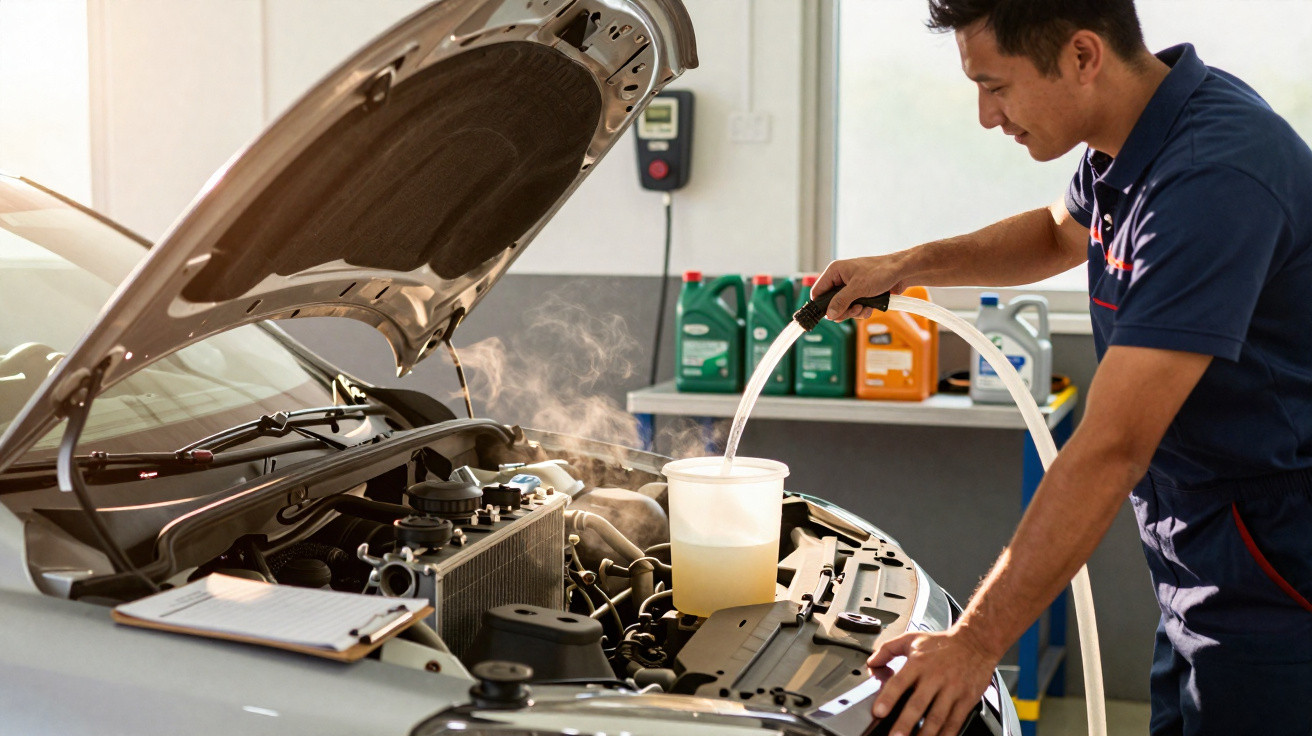
A proper flush begins with a cold engine and a bit of time set aside. A mechanic will raise the front of the car, remove the lower splash shield, and locate the radiator drain plug-or simply detach the lower hose. The old coolant drains into a pan, and its appearance tells you a lot straight away. Bright, clear and slightly fluorescent? That’s encouraging. Brown, gritty, or streaked with oil? Then there’s more going on.
With the radiator emptied, the expansion tank is removed and cleaned, rather than being topped up and ignored. Next comes a flushing agent-a chemical cleaner designed specifically for cooling systems-mixed with plain water and added to the system. The engine is brought up to temperature with the cabin heater set to hot, so the mixture circulates through every part of the system. That circulation stage is exactly what many quick “drain and fill” jobs miss, and it’s the moment years of sludge finally start to shift.
We’ve all met someone who believes a garden hose pushed into the radiator filler neck counts as a full flush. In a small Bristol workshop, a technician tested that approach on a compact SUV: clear tap water was run through until it looked clean, then a section of old heater hose was cut open. The inside still had a thin, gritty coating-like coffee grounds stuck to rubber. Only after using a proper chemical flush and heat-cycling the system did the rinse water run completely clear and the hose interior look almost new.
On a high-mileage diesel, the first flush can carry out dark metallic flecks: old rust and scale. A second rinse followed by a final refill with the correct pre-mixed coolant leaves you with a system that flows properly and protects evenly. Miss out the chemical stage and that abrasive grit remains tucked away in corners, ready to shift and block something when it’s least convenient.
The reasoning is straightforward. Coolant has three core jobs: move heat away, prevent freezing, and inhibit corrosion. Once its additives are exhausted, it still looks like coolant-so it’s easy to neglect. Yet it no longer stops small rust points forming inside the engine block and radiator. Those rough areas become a foothold for mineral deposits. Flow reduces, particularly through narrow channels near the hottest parts of the engine. That’s how a car can overheat even when the coolant level looks “full” and the fan is working hard: the heat simply can’t be shed quickly enough. A complete flush removes the old film, restores the chemistry, and brings back the system’s ability to control temperature under load. The benefit isn’t flashy; it’s the absence of that heart-stopping red warning light in the first place.
Habits and small details that make a flush really count
The gap between “I changed the coolant” and a true radiator flush comes down to small, unexciting details. The best work starts with proper air bleeding. After refilling with fresh coolant, the engine is run with the heater set to maximum and the front end slightly raised, while bleed screws are opened to release trapped air. The burps and gurgles are more important than they sound: trapped air creates hot pockets.
Another low-key but crucial practice is using the correct coolant type for the vehicle’s specification, not whatever happens to be cheapest on a supermarket shelf. Mixing incompatible coolants can make the blend acidic or turn it jelly-like. Flush day is also the ideal moment to examine hoses for soft areas, splits near clamps and swelling. Replacing a hose that’s on the verge of failure now costs far less than dealing with a burst hose on a holiday motorway run.
At a human level, many people treat the cooling system as a sealed black box: they wait for a warning light, then blame the car. A better routine is simple and visual. Once a month, check the expansion-tank level and look at the colour. Watch for dried coolant marks around hose joints. Pay attention to any faint sweet smell after you park. These tiny checks-paired with a proper flush every few years-remove the drama before it starts. Let’s be honest: nobody does this every day. But once a month? That’s realistic.
On the wall of a small Yorkshire garage, there’s a hand-written sign:
“Engines don’t usually die of old age. They die of neglect and heat.”
The owner can match a story to every part of that line: a taxi that reached 400,000 miles because its cooling system was looked after obsessively; a camper van that lost an entire summer holiday thanks to a £3 hose that had clearly been swollen for years. Each time, the pattern repeats: heat wins whenever maintenance loses.
- Flush interval: every 3–5 years, or 50,000–100,000 km, depending on coolant type and manufacturer guidance.
- Always run the cabin heater on full hot during and after a flush to circulate coolant through the heater core.
- Use distilled or de‑ionised water when mixing concentrate coolant to avoid mineral deposits.
- After any flush, recheck coolant level over the next few drives as remaining air pockets work their way out.
- If the radiator fins are bent or packed with debris, gently clean them from the back with low‑pressure water, not a harsh jet wash.
| Key point | Details | Why it matters to readers |
|---|---|---|
| Use the right coolant type | Match the coolant to your car’s spec (OAT, HOAT, etc.) and avoid mixing different colours unless they’re explicitly compatible. | Wrong coolant chemistry can eat away gaskets, clog passages and cut engine life, even if the level looks fine. |
| Flush, don’t just drain | A simple drain removes only 40–60% of old coolant; a full flush with cleaner and multiple rinses can remove nearly all of it. | Leaving half the old fluid inside keeps corrosion and sludge circulating, so overheating risks stay roughly the same. |
| Bleed air properly | Run the engine with heater on hot, use bleed screws, and massage upper hoses until bubbles stop appearing in the tank. | Air pockets create local boiling and temperature spikes that can crack heads and warp alloy components over time. |
| Inspect hardware during the flush | Check hoses, clamps, radiator core, water pump weep hole and thermostat housing while everything is drained and visible. | Spotting a weeping pump or cracked hose at home is far cheaper and less stressful than a breakdown on the motorway. |
Driving away from the flush: what changes and what doesn’t
Driving home after a fresh flush, nothing feels transformed. The engine sounds the same, and the throttle response won’t suddenly sharpen. The meaningful difference is largely hidden-and frankly a bit dull: the temperature gauge tends to sit slightly lower in slow-moving traffic, and it stays steady. Boring is beautiful when you’re climbing a long hill with a trailer on the back.
In hot, stop-start city driving, you may notice the fans switching on and off in a more consistent pattern. On cold mornings, the heater can reach full warmth sooner because coolant is moving efficiently through a clean heater matrix. Long motorway journeys feel less like a risk and more like what they should be: uneventful. On an older vehicle, even a lingering whiff of hot coolant inside the cabin can disappear after a proper flush and a refresh of tired hoses.
There’s also a subtle shift in how you think about the car. Instead of something you only respond to when it fails, it becomes something you look after with intent. Practically, a flush can extend the working life of the water pump, thermostat and radiator-often by years. Personally, it buys peace of mind on the days you really don’t want to see steam in the rear-view mirror: a late-night drive with a sleeping child in the back, a packed holiday run, or a long commute after a grim day at work. With so many distractions on modern roads, a calm, stable temperature gauge is a small but solid comfort-one less problem to manage, and a useful conversation to have with anyone who’s been ignoring a rising needle.
FAQ
- How often should I flush my radiator? Most modern cars are fine with a full flush every 3–5 years or about 50,000–100,000 km, depending on the coolant type and what the manufacturer recommends. If you tow regularly, drive in extreme heat, or see rusty coolant, doing it a bit sooner is cheap insurance.
- Can I just top up the coolant instead of flushing? Topping up is fine in an emergency, but it doesn’t reset the chemistry or remove sludge. If the existing coolant is old or discoloured, adding fresh fluid just dilutes a problem that’s still quietly damaging your cooling system.
- Is a radiator flush something I can do at home? Yes, if you’re comfortable working on your car and have a way to dispose of old coolant properly. You’ll need basic tools, a flushing agent, the correct coolant, and time to bleed the system. If bleeding and spill‑control sound stressful, a trusted garage is worth the cost.
- What happens if I mix different coolant colours? Colour isn’t a precise guide, but mixing random coolants can cause them to separate, thicken or become more corrosive. If you’re unsure what’s in there now, a full flush and refill with a known, correct type is safer than guessing.
- Are chemical flush products safe for older engines? Used as directed, reputable flush agents are designed to be gentle on metal and harsh on deposits. On very neglected engines, they may reveal existing weak spots like rotten hoses or a failing radiator, but that’s a sign those parts were already on borrowed time.






Comments
No comments yet. Be the first to comment!
Leave a Comment