
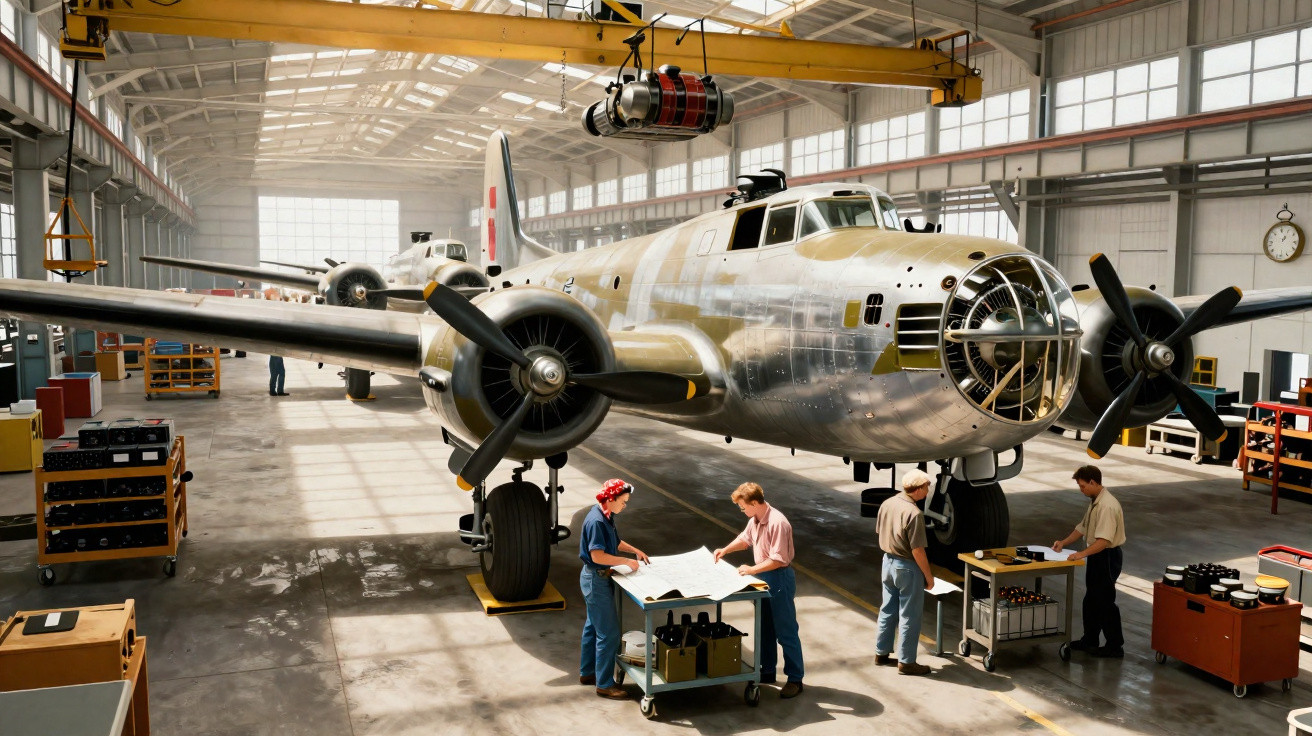
Well away from the fighting, US engineers and factory hands were working on a challenge no military had previously encountered: a production system so vast and so rapid that it could transform raw aluminium and steel into a finished heavy bomber in little more than an hour.
The day war became a production race
Studying the world map in late 1940, President Franklin Roosevelt understood that America could soon be pulled into the Second World War. He also grasped a hard truth: victory would not come from manpower on its own.
Germany’s forces had already been toughened by combat, while the US Army remained relatively small and poorly supplied. Yet Washington held a different strength-industrial capacity: car plants, steelworks, skilled labour, rail networks and plentiful oil.
Roosevelt decided to press that advantage as far as it would go. Long before large numbers of American soldiers reached Europe, he called for aircraft in the tens of thousands. In doing so, he helped turn the conflict into a contest of output and organisation, not only ships and armies.
The most powerful US weapon of the early 1940s was not a secret plane or a new tank, but a mile-long factory that could build a bomber from scratch in 63 minutes.
To hit the extraordinary totals Roosevelt demanded, the federal government turned to the people who best understood mass production: Detroit’s car-makers.
From Model T to heavy bombers
The Ford Motor Company-famous for reshaping car manufacturing with the moving assembly line-was initially approached to produce parts. It soon became obvious to Ford’s leadership that supplying components alone would never satisfy wartime demand.
Ford therefore opted for a far bolder plan: build the entire B-24 Liberator, a four‑engined heavy bomber that Consolidated Aircraft in California was already producing in limited numbers.
This was not a small aircraft by any measure. The B-24 was over 20 metres long, had a wingspan of roughly 33 metres, could carry up to 3.6 tonnes of bombs, and flew with a crew of as many as ten. The notion of turning out machines like this as if they were inexpensive saloon cars bordered on the ridiculous.
At Consolidated’s existing sites, each bomber was treated much more like a bespoke job. Workers completed subassemblies outdoors, exposed to the weather; rain and snow routinely slowed progress. Production was counted in small batches, not in the hundreds.
An L-shaped monster in the Michigan fields
Early in 1941, Ford won a contract to build B‑24s and immediately began creating a facility unlike anything that had come before. The chosen location was Willow Run, around 50 kilometres from Detroit.
The factory covered about 325,000 square metres (roughly 3.5 million square feet) and extended to around a kilometre from end to end. Its distinctive L-shaped footprint was not decorative: it let the plant wrap around a proposed runway while staying inside a single county, reducing local tax costs.
Materials and major components entered at one end-sheet metal, engines, wiring, undercarriage assemblies. At the other, completed bombers emerged and rolled directly to the runway for test flights. Everything about the layout was designed for one purpose: remove minutes wherever they could be found.
Willow Run was built like a weapon in its own right: every wall, doorway and workbench was positioned to shave seconds off the bomber’s journey from blueprint to take-off.
Breaking down a bomber into car-sized jobs
The method at the heart of Willow Run was shaped by Charles Sorensen, Henry Ford’s trusted production chief. After seeing the hand‑built bomber lines on the US West Coast, he drew up a fundamentally different system-reportedly in a single night.
In principle it was straightforward, but in practice it was extremely difficult: split the B‑24 into subassemblies that could be produced simultaneously, then feed them into one continuous moving line.
- Fuselage sections were assembled along one sequence of work stations.
- Wings progressed down a separate line, laid flat, like enormous car doors.
- Tail assemblies, undercarriage and engine nacelles moved forward on their own tracks.
- In final assembly, every stream converged on the main line, and the bomber took form step by step.
The engineering burden was enormous. Thousands of Consolidated drawings arrived with gaps, contradictions or outright mistakes. To prevent the line descending into confusion, Ford engineers had to redraw, rationalise and standardise parts at speed.
Chaos, turf wars and then lift‑off
Willow Run’s first months were anything but smooth. Parts of the factory were still under construction while aircraft were being built inside. Unpaved areas let mud creep in, tools could not be found when needed, and supply deliveries did not always arrive on time.
Organisational problems compounded the disruption. Responsibility was divided between Ford and Consolidated, design changes came through late, and there was no single individual with the authority to settle arguments about fit, tolerances, or which drawing revision should be followed.
Progress only began to accelerate once the US government placed Willow Run’s bomber programme under one management team with clear authority. Work routines steadied, tooling aligned with current blueprints, and training became consistent.
Once one clear chain of command ran the plant, Willow Run stopped behaving like a construction site and started behaving like a machine.
After that shift, the plant’s capacity became visible. Jigs and fixtures meant components lined up correctly the first time. Inspections were integrated into the assembly process rather than left until the end. Timetables became dependable.
The moment the line outran the Luftwaffe
By 1944, Willow Run was reaching outputs that astonished even its own planners. A fully assembled B‑24 was leaving the line every 63 minutes, and in its best month the factory shipped 428 bombers.
Germany could not approach those totals. Its aircraft production leaned on smaller factories, craft-based methods, and designs that were difficult to standardise. On top of that, Allied bombing repeatedly disrupted manufacturing.
| Country | Main heavy bomber type | Approximate total built |
|---|---|---|
| United States | B‑24 Liberator | 18,400+ |
| United States | B‑17 Flying Fortress | 12,700+ |
| Germany | Heinkel He 111 | 6,500+ |
| Germany | Junkers Ju 88 | 15,000+ (mixed roles) |
These totals make the imbalance clear: one US heavy bomber type, produced through one enormous programme, could match-or exceed-the combined output of multiple German production lines.
The real secret: 43,000 people
Although Willow Run looked like a vision of the future, its real strength was human labour. At peak, the site employed roughly 42,000 to 43,000 people, many of whom had never worked in a machine shop before the war.
With so many able-bodied men in uniform, the factory relied heavily on women. They were trained quickly to rivet, weld and wire, and some were tasked with squeezing into tight wing spaces that larger workers simply could not access.
The familiar image of “Rosie the Riveter”-rolled sleeves and a self-assured stare-was shaped in places like this. While it served propaganda needs, it also reflected a genuine transformation on the factory floor.
At Willow Run, the US did not just mass-produce bombers. It mass‑produced new kinds of workers: women, migrants and young people who discovered they could master precision jobs in weeks, not years.
Over time, the plant became a small world of its own. It offered canteens, medical clinics, sports pitches, and dedicated bus services from Detroit and neighbouring communities. For many, life on the bomber line provided both income and a ready-made social network.
Why Germany could not keep up
Germany certainly had skilled engineers and produced some sophisticated aircraft, but its broader system made a Willow Run-style operation hard to sustain.
Frequent design revisions undermined standardisation. Labour shortages, combined with political decisions, led the regime to depend on forced labour rather than structured training. Production was dispersed to reduce vulnerability to air raids, which in turn complicated transport and logistics.
The United States, in contrast, focused on centralising and simplifying. Once a particular bomber variant was set, it was built in huge runs with few alterations. Supply networks delivered directly into massive plants sited close to rail routes and major roads, enabling steady, repeatable output.
From B‑24 to B‑29: a short reign
The B‑24 Liberator became a key aircraft in bombing campaigns across both Europe and the Pacific. It undertook long-range sorties targeting oil facilities, U-boat bases and transport systems.
But progress was rapid. By 1943, Boeing’s B‑29 Superfortress introduced pressurised cabins, remote-controlled gun turrets and even greater range, pointing strategic bombing towards more advanced designs.
Even so, Willow Run continued producing B‑24s into the final stage of the war. Ultimately, more than 8,600 Liberators were built there before the lines stopped in 1945. Afterwards, parts of the site were repurposed for peacetime manufacturing and, later on, museum initiatives.
What Willow Run tells us about modern industry
The rise of this gigantic bomber plant demonstrates how quickly an industrial economy can be retooled when there is a clear objective, vast funding and strong political commitment. It also illustrates ideas that still shape manufacturing.
One of these is the supply chain. Rather than a single site making every component, separate firms produced engines, instruments, tyres and radios, which then flowed into Willow Run for assembly. A delay anywhere in that chain could stop the line, meaning coordination mattered as much as the machinery.
Another is standardisation. By locking down specific versions of parts and procedures, Ford reduced mistakes and shortened training. The same logic underpins modern electronics, cars and even smartphones: shared components and repeatable processes.
Yet there is a cautionary note. Systems tuned for maximum volume often struggle to remain adaptable. When the B‑29-and later jet aircraft-became the new priority, facilities like Willow Run had to be redesigned or left behind. Money sunk into buildings and tooling did not automatically translate into long-term value.
Imagining a Willow Run for today
A present-day equivalent might be organised around drones or batteries rather than bombers. A kilometre-long complex could produce thousands of long‑range surveillance drones each month, or assemble electric car batteries at remarkable speed.
The upside is clear: lower cost per unit, fast scaling, and the ability to saturate a market-or a battlefield-with equipment. The vulnerabilities are equally clear: a cyberattack, a supply shock, or a political decision could disable the entire operation.
Willow Run’s experience points towards balance. Huge, ultra-efficient hubs can deliver astonishing volumes when required, but they are strongest when paired with smaller, more agile sites that can respond to fresh designs and sudden disruptions.
In the 1940s, that balance swung sharply towards the United States. As German factories struggled to restart after each air raid, a Michigan plant kept sending four‑engined bombers skyward-one every 63 minutes-until the production figures themselves became a kind of weapon.



Comments
No comments yet. Be the first to comment!
Leave a Comment