
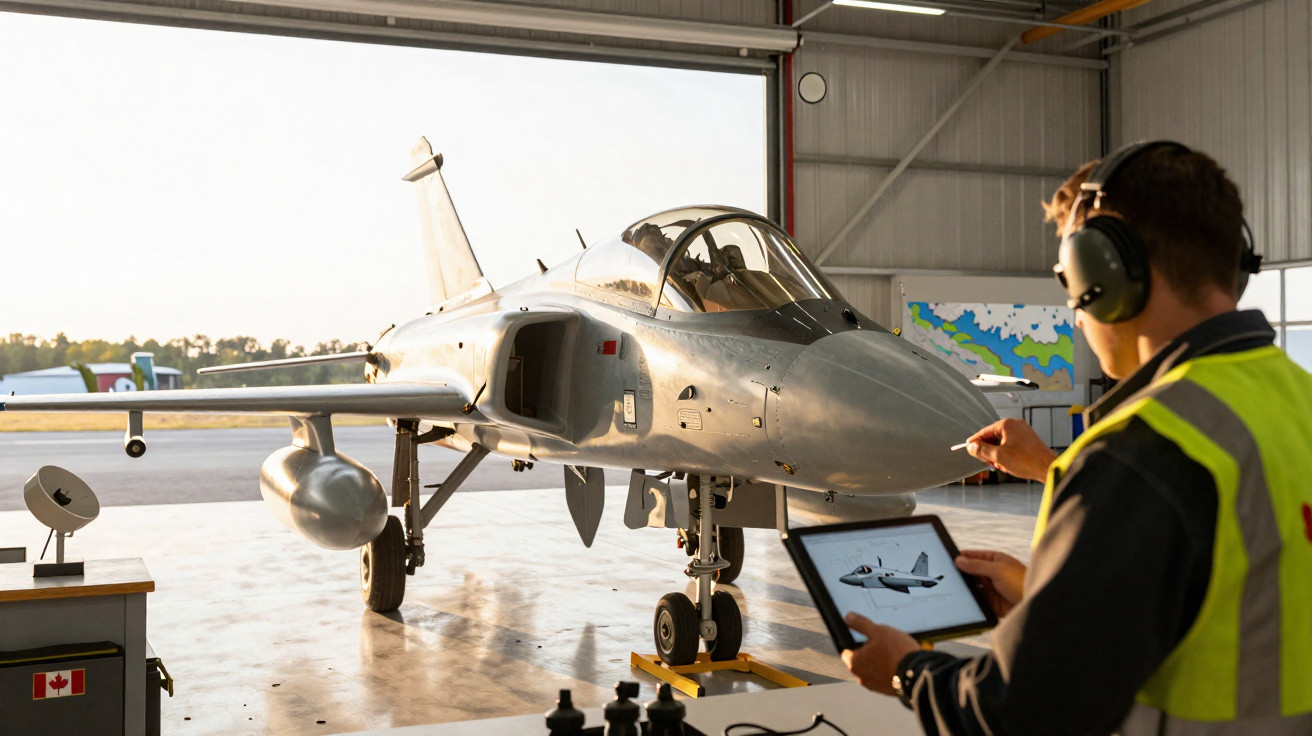
Canada’s decades-long effort to choose its next combat aircraft has moved beyond questions of performance figures and delivery timelines. It is now a strategic inflection point, as Sweden’s Saab promotes the Gripen as both an alternative to-and a potential partner alongside-the US-made F‑35.
A fighter deal that reaches far beyond the runway
A fresh chapter opened around Sweden’s King Carl XVI Gustaf’s state visit to Canada. Although the official messaging centred on co-operation and Arctic security, Saab used the attention to restate a sweeping offer: establish a Gripen final-assembly line, a research and development centre, and a manufacturing hub in Canada.
Saab is effectively offering Canada a role as a core industrial pillar of the Gripen programme, not just a customer at the end of the chain.
The condition is plain. Saab’s executives have indicated that the industrial package only comes with a Canadian purchase of Gripen aircraft for the Royal Canadian Air Force (RCAF). If Canada does not operate the aircraft, there is no major technology transfer, no domestic assembly, and no sustained jobs programme.
For any government chasing high-value industrial work, the scale is eye-catching: Saab points to 9,000 to 10,000 jobs over several years, linked to producing and supporting aircraft for Canada, for European partners and-possibly-for Ukraine, should Stockholm and Ottawa support those exports.
All-in on F‑35 or mixed fleet with Gripen?
At the heart of the debate is a basic issue: what should Canada’s future fighter force actually look like?
Ottawa has already decided to acquire 88 Lockheed Martin F‑35s. That choice pulls Canada closer into US and NATO air-power structures, particularly through the North American Aerospace Defense Command (NORAD), responsible for monitoring airspace across the Arctic and the wider North American region.
The case for a pure F‑35 fleet
Backers of a single-type fleet say an all–F‑35 approach reduces complexity across the board. The aircraft’s low-observable design is intended to penetrate heavily defended airspace early in a conflict. It is also built to plug into NATO and NORAD’s expanding mesh of sensors, data links and command-and-control networks.
- A single training stream for pilots and ground personnel
- Common maintenance equipment and shared spares
- Straightforward integration with US and allied operations
- Strong suitability for Arctic surveillance and strike tasks
A number of former RCAF leaders favour this route. In their view, operating two fighter types typically means added cost, more moving parts to manage and a larger margin for friction when time is critical.
What a mixed Gripen–F‑35 fleet could offer
Saab and sympathetic politicians propose a different model. Under this approach, Canada proceeds with its planned F‑35 purchase while also bringing in a quantity of domestically assembled Gripen E aircraft. The F‑35 would take on stealth-intensive, top-tier roles, while Gripen would provide additional capacity, adaptability and redundancy.
Gripen advocates argue that more airframes on more bases, flying from shorter or rougher runways, could thicken Canada’s air defence where it is currently thin.
Gripen was developed with harsh and dispersed operations in mind. It can be turned around quickly by small crews, fly from short runways or dispersed stretches of roadway, and rely on mobile support packages. For a country defined by remote communities, extensive coastlines and exposed Arctic locations, that operational flexibility is an obvious selling point.
However, the compromises are substantial. Two fighter types bring two primary logistics systems, a wider range of spares, separate technical training tracks, and different pathways for software updates and weapons integration. With defence finances under pressure, that extra spending layer prompts difficult choices.
Industrial policy, not just defence planning
Saab’s proposal arrives as Canada revisits its broader defence-industrial strategy. Industry Minister Mélanie Joly has publicly referenced the Swedish offer as potential leverage in discussions with Washington. Canada is simultaneously engaged in several trade disputes with the United States and is seeking improved terms on defence workshare and access to technology.
By keeping Gripen on the table, Ottawa signals to the Pentagon and US industry that it is prepared to direct major procurement spending elsewhere if the value proposition is stronger. That signal carries weight as Canada faces calls to increase defence expenditure, particularly for the country’s northern approaches.
| Option | Main benefit | Key risk |
|---|---|---|
| All F‑35 | The deepest integration with US and NATO systems | Heavy reliance on US supply chains and policy decisions |
| Mixed F‑35/Gripen | A domestic industrial footprint and greater fleet flexibility | Increased long-term running costs and training burden |
For Sweden, the stakes are also significant. A Canadian production hub would bolster Gripen’s standing in Europe, potentially support Ukrainian requirements if political conditions permit, and give Saab a North American base that goes beyond marketing and sales.
How this shapes Arctic and NATO security
How Canada ultimately configures its 88 new fighters will broadcast its strategic orientation. An all–F‑35 fleet would embed Canada firmly within a US-led ecosystem for Arctic surveillance and deterrence, keeping Washington central to data exchange, software updates and capability growth.
Adding Gripen would shift part of that dependence towards a European partner. It could deepen links with Swedish and wider Nordic defence networks, which are gaining prominence as NATO pays closer attention to its northern flank.
The choice is not simply about which aircraft flies faster or carries more weapons; it is about where Canada situates itself between American and European defence structures for decades.
The decision also touches on assistance to Ukraine. A Gripen line in Canada could, at least theoretically, be used to produce aircraft or spares for Kyiv if Sweden, Canada and allied partners opted for that approach. That adds a further geopolitical dimension to what might otherwise look like a straightforward procurement matter.
Key concepts behind the headlines
What NORAD actually does
NORAD is the binational command shared by Canada and the United States, responsible for detecting and responding to possible airborne threats to North America. That can include Russian long-range bomber activity in the Arctic as well as unknown aircraft within domestic airspace.
For NORAD, interoperability is a practical requirement rather than a slogan. It means an aircraft’s sensors, radios and data systems must connect smoothly with American and Canadian command centres. The F‑35 is designed around this principle. Gripen can also connect, but it would require bespoke integration work, testing and jointly agreed procedures.
Why industrial offsets matter
Large defence acquisitions often include “offsets” – bundles of industrial activity, technology transfer or investment tied to a contract. Saab’s proposed Canadian Gripen hub is a textbook illustration. The premise is that public spending on aircraft is recaptured through jobs, expertise and export opportunities.
For Canada, such a hub could translate into thousands of specialised positions in aerospace engineering, software, advanced manufacturing and maintenance. Those capabilities often spill into civilian industries-ranging from commercial aviation to high-technology research-which is why governments frequently press for substantial offset packages.
Scenarios that could shape the next decade
From this point, several outcomes are credible. Ottawa might keep to the existing F‑35 plan while using the Gripen discussions mainly to strengthen its hand with Washington. That would maintain alignment with allies already flying the aircraft, including the US, UK, Italy and others, while still pursuing improved industrial participation.
A second option is a staged introduction of Gripen alongside the F‑35, potentially allocating the Swedish fighter to domestic air policing and Arctic patrols from more austere locations. The F‑35s could then focus on expeditionary deployments and operations in highly contested environments.
There is also a political vulnerability: what looks compelling on paper with a dual fleet may not withstand future budget tightening. Training systems can be consolidated, bases can be shut, or one aircraft can be favoured over the other as governments rotate in and out. Defence planners are well aware that commitments made at contract signature do not always endure across two or three election cycles.
For Canadian pilots, technicians and the communities that support them, the consequences could diverge sharply. One route offers stable work tied to US-linked supply chains and regular joint training with American units. Another creates a Swedish–Canadian industrial partnership, new aerospace clusters and a broader set of day-to-day operational relationships.




Comments
No comments yet. Be the first to comment!
Leave a Comment