
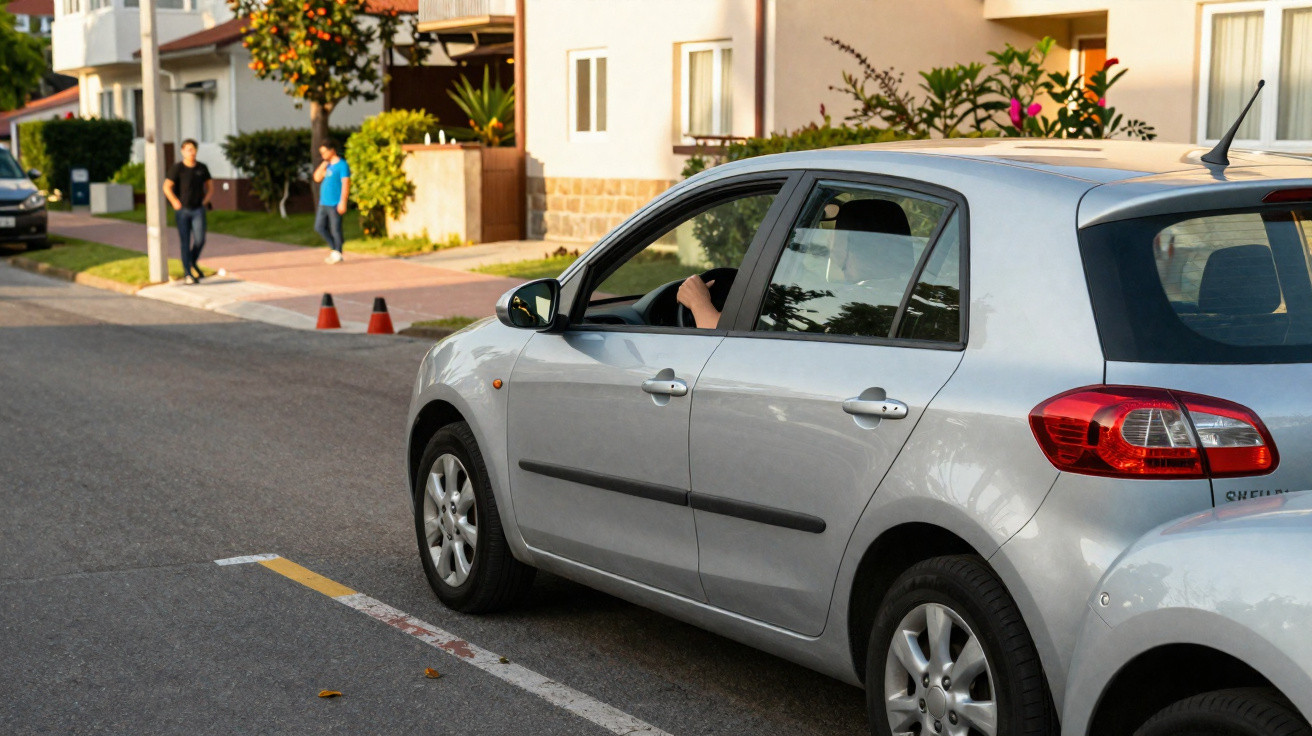
You don’t truly discover what kind of driver you are until you try to parallel park with eyes on you. Suddenly your palms sweat against the steering wheel, your mind goes blank, and you inexplicably “forget” which way to steer. The lane behind feels narrower, the queue of cars turns into a crowd, and you can practically sense someone in a café lowering their latte to assess every twitch of the wheel. It’s absurd, because you’ve done it loads of times. Still, your pulse jumps.
There is, however, one small technique that neatly separates the people who slip into a gap from the ones who end up skewed, flustered and red-faced: set your side mirror level with the rear bumper of the car in front before you start turning. It sounds almost laughably basic. But once it clicks, you can’t unknow it.
The night I became “that” driver
For ages, I was the person who’d loop the same streets rather than commit to a tight parallel space. I’d tell myself I was “trying for something easier”, but really I was scared of tapping somebody else’s pride and joy - or scuffing my own. Then, on a damp Tuesday evening in Manchester, after a long day followed by an even longer drive, I found the gap that called me out. It was outside a friend’s flat, wedged between a white Golf and a black BMW that looked pricier than my prospects.
I can still picture the streetlamp reflecting off rain-polished tarmac, and the small, hard knot in my stomach when my mate said, “You’ll fit. Go on.” It didn’t look possible. The space seemed about as long as my car, plus one lonely crisp packet. My wipers squealed over the windscreen, the radio muttered something instantly forgettable, and I genuinely thought: this ends with a row about someone’s alloy.
My friend leaned across, gestured at the car ahead, and said, “Line your side mirror up with their back bumper, then turn the wheel. That’s your spot. Don’t turn before. Don’t panic after.” No one had ever put it so plainly to me. One clear reference point. One rule to follow. I tried it, creeping back bit by bit, bracing for a crunch that never arrived.
When the car eased into the space as if it already knew the route, I stayed still for a moment, listening to the engine tick as it cooled. Rain drummed lightly on the roof. A passer-by went by with a takeaway and didn’t even glance at me. Parallel parking had always felt like guesswork stitched together with hope. That night, for the first time, it felt like a calm, repeatable manoeuvre I could actually rely on.
The golden rule that shrinks any parking space
This is the essential point: you only begin turning once your side mirror is lined up with the car in front’s rear bumper. Not when it “seems close enough”. Not when the driver behind starts creeping and sighing. That tiny visual check changes the whole process from a vague art form into something much nearer to muscle memory. For a moment, it lets you tune out the noise and trust one simple alignment.
As soon as your mirror reaches that invisible line with their bumper, your car is at the right starting angle for the reversing arc - without cutting in too sharply. Turn decisively towards the kerb, keep reversing at a crawl, and the car begins to tuck in. You’re no longer relying on luck that you won’t swing into the vehicle behind. You’re following a track. The gap that looked like a personal insult a second earlier starts to feel like a problem you already know how to solve.
We’ve all watched someone else glide into a space in one smooth motion and felt about twelve years old. This is often the reason, even if they wouldn’t describe it the same way. They’ve learned the point their car likes to start turning. The mirror-and-bumper cue simply gives that instinct a clear, repeatable trigger - especially on the days your head feels scrambled and your confidence has quietly gone missing.
Why that mirror-bumper moment actually works
A car isn’t a neat rectangle you can shuffle on paper; it pivots, swings and plays tricks with your judgement. The rear and front trace different paths, and that mismatch is where most of the fear comes from. The mirror-to-bumper alignment is basically a shortcut through the geometry: it’s the moment when your rear wheels and the space behind you are properly set up for what happens next.
Start the turn too early and the front swings out, menacing the car ahead. Leave it too late and you finish wide of the kerb, leading to that humiliating shuffle of full lock, forward, back, forward, back, as your composure leaks away. That side-mirror moment quietly removes the maths. It just tells you: begin turning here - not sooner, not later. After you’ve felt that clean angle a few times, your body remembers it even when your mind is elsewhere.
The psychology of the watching world
Parallel parking isn’t truly a battle with the kerb; it’s a battle with embarrassment. The dread isn’t “I might need two attempts”; it’s “people will see I need two attempts”. In your head, the barista is smirking in the window, the passenger behind is muttering, the cyclist is rolling their eyes as you edge back and forth. The pressure starts the moment you indicate, and suddenly ordinary movements feel loaded.
And honestly, hardly anyone does this daily with an examiner’s gaze and perfect textbook form. Most of us take the easiest half-legal bay we can find in a supermarket car park, then every few weeks a cramped city-centre space appears and says, “Still got it?” By then the comfort has faded and the nerves have sharpened. The golden rule gives your brain something small, solid and practical to hold on to when the inner critic pipes up.
Something else shifts, too, once you know you’ve got a “move”. Panic is replaced by a quiet, private choreography. You reverse steadily, watch the mirror meet the bumper, and start the turn with a faint half-smile because you know what happens next. The onlookers fade into background static. It’s almost like you and the car share a secret.
When it all goes wrong anyway
Some days, the rule won’t rescue you. Maybe the car in front is parked miles from the kerb; maybe the space is on a slope; maybe there’s a skip sticking into the carriageway and a taxi pressed up behind you. You line up, you turn, and suddenly you’re too close or too far - or a mysterious van appears at speed and sits on your bumper. This is where the emotional side of driving really shows.
Your shoulders creep upwards, your jaw clamps down, and your breathing turns shallow. You start questioning everything - the steering angle, the turning point, even your general competence. But you still have the same anchor: that first alignment. If it isn’t working, reset. Pull out, line up again, breathe, and try a gentler turn. It isn’t a promise of flawless parking; it’s a calm starting point you can return to when the road feels chaotic.
Learning the rule on a quiet street
One of the best favours you can do yourself is to practise when nobody’s watching, not when the pressure’s on. Find a quiet residential road on a Sunday morning, when the parked cars sit in a sleepy line and no one’s in a hurry. Pick a roomy gap and rehearse: draw up parallel, ease forward until your mirror aligns with the car ahead’s rear bumper, then begin the turn. No horns, no shouting kids, no cyclist squeezing past your rear.
At first, it can feel awkward and artificial. You might obsess over where “exactly” your mirror matches “exactly” which point of their bumper. The aim isn’t millimetre accuracy; it’s building a repeatable habit you can lean on. After a few attempts, something almost boringly comforting happens: you end up roughly where you should be, again and again. That predictability is exactly what your nerves have been asking for.
A learner driver I spoke to said his instructor insisted he spoke the steps aloud every time. “Mirror with bumper. Stop. Full lock. Slow reverse.” He told me it seemed silly at first, like a little nursery chant. Then, one day, reversing into a space outside a busy Tesco, he caught himself murmuring the same words and realised he was… calm. Calm, in a supermarket car park. That’s how you know the manoeuvre has settled into your bones.
Adjusting for your own car
Not every car has the same proportions, and this is where you tailor the rule to suit you. In a small city runabout, you may find you can begin the turn a fraction earlier. In a long estate car, it might feel better to pull slightly further alongside before you commit. The underlying idea stays the same: your side mirror and their rear bumper share a brief, crucial alignment. That’s your signal.
You’ll also discover minor preferences that fit your style. Perhaps you like your mirror level with the far edge of their bumper rather than the middle. Perhaps you prefer one confident sweep to full lock instead of a series of tentative nudges. Once that landmark is tuned to your car, it becomes your personal golden rule - not a line from a manual, but a small ritual between you and the vehicle.
The small, stubborn pride of getting it right
There’s a particular satisfaction in stepping out and seeing your car sitting neatly in line between two others. Not showy, not overly perfect - just tidy and assured. Your tyres are a sensible distance from the kerb, the nose isn’t sticking out, and the rear isn’t awkwardly angled. You lock up and walk off with a private, slightly smug warmth. Nobody else cares. You do.
Parallel parking becomes less of a test and more of a signature once you have a move you trust. It’s like having your preferred way to tie a scarf or make a brew. Other people may do it differently, but this is your method, and it works. The mirror-bumper cue becomes part of that signature: a quiet decision to learn the dance rather than gamble on it every time.
We tend to talk about driving skills as though they’re all dramatic - emergency stops, joining a motorway, catching a skid in the rain. But most driving is made up of smaller, unglamorous moments that quietly shape your day: fitting into a tight spot outside the dentist, sliding between two strangers’ cars on a side street, edging close to the kerb on the school run. The golden rule belongs to that everyday magic - the stuff nobody applauds, but you measure yourself by.
When the golden rule follows you off the road
Oddly, a small trick like this can travel into the rest of life. You start noticing how much fear shrinks once you find a reliable reference point. A presentation becomes easier when you know the one slide you must get right. A difficult conversation feels less sharp when you know the one sentence you need to say. Parking turns into a metaphor you never asked for, but can’t quite unsee.
That moment when your mirror lines up with the bumper feels like a tiny act of faith in yourself. You’re trusting that if you begin there, you’ll land more or less where you need to be. Life doesn’t offer kerbs and painted lines for everything. Sometimes it only gives you a rough cue and asks you to move anyway. The road behind might be busy, the spectators may be real or imagined, but your hands still turn the wheel.
On the rough days, you’ll mess it up and need to straighten. People will watch. Someone might even lean on the horn. But once you’ve felt the steady usefulness of that golden rule, the sting doesn’t cut as deep. You know it works. You know you can reset, line up again, and take another go. That’s the quiet grace of this little driving trick: it doesn’t guarantee perfection - only a dependable place to start.
The next time you see a tiny gap
So, next time you’re crawling along a busy street with rain ticking at the windscreen, and you spot a space that looks almost - but not quite - big enough, don’t automatically drive on. Pause and ask what would happen if you simply tried. Indicate. Take a breath. Pull alongside. Let your side mirror edge forwards until it sits level with the rear bumper of the car in front - that small rendezvous point that only you are paying attention to.
Then steer. Do it slowly but with intent, as if you’ve rehearsed on a calm, empty street a hundred times. The kerb won’t hurry you. The other cars won’t suddenly leap forward. The honk you’re expecting usually never comes. What does arrive, if you allow it, is that compact, fierce jolt of satisfaction when the car settles into place and you realise you managed it - not by luck, but by choice.
You turn the engine off, sit for a beat in the soft tick of cooling metal, and might even catch yourself smiling in the rear-view mirror. Outside, the world carries on, oblivious. Inside, you’ve taken one of driving’s most dreaded manoeuvres and turned it into a private, practised skill. And it began with a side mirror, a bumper, and a decision to trust the golden rule.



Comments
No comments yet. Be the first to comment!
Leave a Comment