
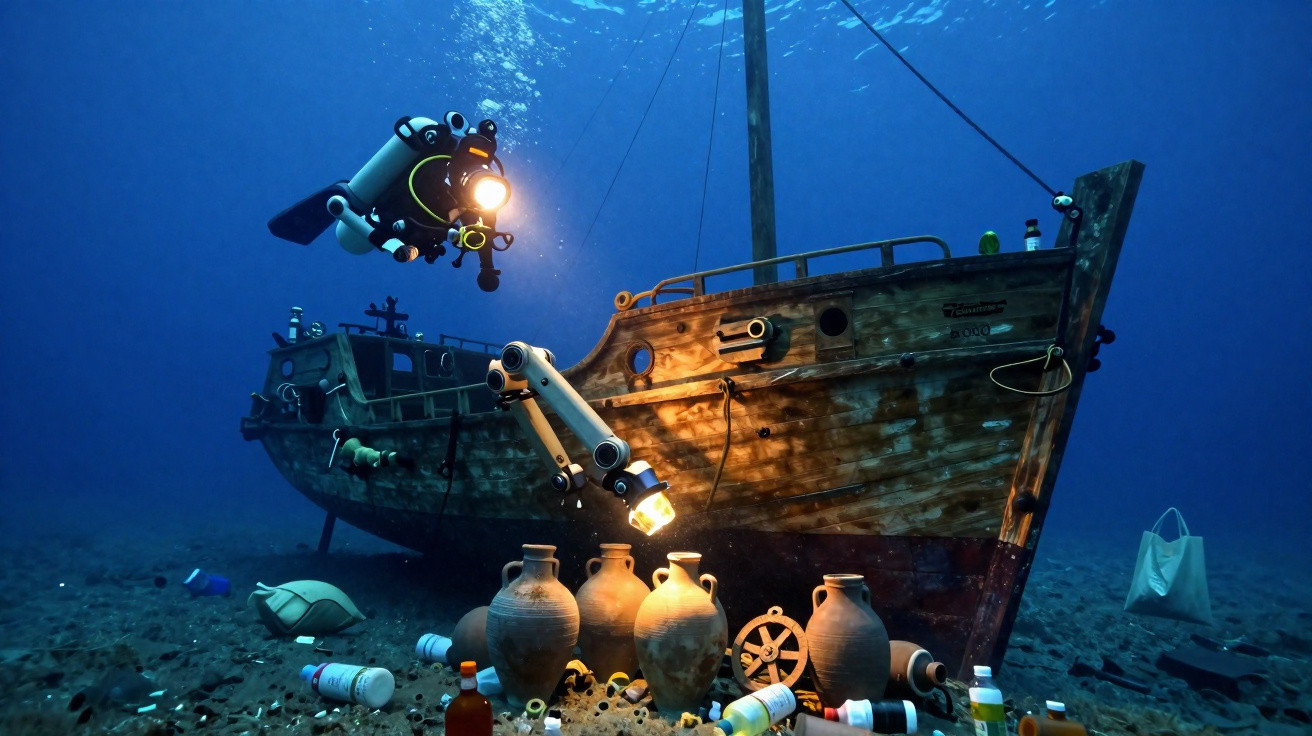
A contact that initially registered as an indistinct sonar return is now understood to be an exceptionally well-preserved 16th‑century merchant ship, standing upright in the cold, lightless Mediterranean. According to researchers, this wreck-known by the nickname “Camarat 4”-may subtly recalibrate what we know about Renaissance-era trade, travel and shipboard defence.
An accidental find that redrew the chart
The discovery was close to being missed altogether. In early March 2025, a French Navy ship was conducting routine deep‑sea training off Ramatuelle, near Saint‑Tropez. The seabed was being checked with multibeam sonar, largely to identify hazards and geological features. One target, however, refused to blend in: its crisp lines, arched profile and repeated edges looked unlike anything formed by natural processes.
A remotely operated vehicle (ROV) was then deployed. When its lamps cut through the darkness 2,500 metres below the surface, the blurred shape resolved into a 30‑metre wooden hull, upright on its keel. It appears to have come to rest gently on a layer of silt-no evidence of a violent disintegration, no scattered framework-just a ship that ceased moving five centuries ago and, remarkably, was left alone.
The wreck lies more than 2,500 meters deep, making it the deepest known shipwreck in French waters and a rare intact time capsule from the 1500s.
Down there, sunlight never reaches. Temperatures sit only slightly above freezing, currents are sluggish, and organisms that normally consume timber struggle to thrive. Together, these conditions act as a natural strongroom, protecting the site from storms, anchors and looters-the familiar forces that have steadily degraded shallower Mediterranean wrecks for decades.
Inside “Camarat 4”: ordinary cargo, extraordinary insight
When specialists at DRASSM (France’s Department of Underwater and Submarine Archaeological Research) examined the video, they did not find a haul of coins or glittering “treasure”. What they did see was arguably more revealing: the domestic objects of everyday life-items that once belonged on household shelves and dining tables.
Large areas of the hull are carpeted with hundreds of ceramic jugs. Many are decorated with painted flowers, vine motifs and sharp geometric patterns. Others bear the IHS monogram, a Christian emblem associated with the name of Jesus and widely used in Catholic Europe at the time. Such features point towards production in Liguria in northern Italy, a region known for manufacturing export tableware.
Close by, the team identified piles of yellow‑glazed plates and grouped bundles of metal bars. The bars-probably iron-may have been carried both as saleable material and as ballast, adding weight and improving stability in heavy seas.
The cargo suggests a working merchant ship, loaded with mass-market goods from Italian workshops and heading toward consumers along the western Mediterranean coast.
Six cannons lie along the flanks of the wreck, several partly embedded in sediment. A substantial anchor sits near the bow. Cooking vessels and what seem to be navigational instruments are also visible across the site. Viewed together, the assemblage outlines a ship operating on busy routes where commercial opportunity and threat travelled side by side.
What the cargo reveals about 16th‑century trade
Historians already regarded the Gulf of Saint‑Tropez as a key corridor of movement in the 1500s. Other wrecks nearby-such as the Lomellina and Sainte‑Dorothéa-have yielded luxury items, weaponry and raw materials. Camarat 4 strengthens the picture in a different way: it captures the routine goods that supplied ordinary consumers, not only elite households.
- Ceramic jugs: likely household and tavern containers for wine, olive oil or water.
- Glazed plates: everyday tableware for the middling sort, with ornamentation that signalled taste and regional origin.
- Iron bars: a practical commodity destined for tools, weapons or building work, probably traded on further west.
- Weapons on board: cannons and smaller arms point to anxieties about piracy and privateers.
This combination sits comfortably within a coastal trading system running from Liguria towards Provence and Catalonia, where Italian ceramics found eager markets. In these stacks of clay and iron, researchers see a compact record of how consumer demand, religion and maritime security intersected during the early modern era.
Robots on site: investigating a wreck beyond human reach
At Camarat 4’s depth, no scuba diver can work. Pressure on the seabed exceeds 250 times what we experience at the surface, so every moment of observation depends on machinery.
The French team began by outlining the area with sonar, before sending down ROVs equipped with LED lighting, 4K cameras and robotic arms. The vehicles crept over the wreck, collecting thousands of overlapping photographs from pre‑planned angles. Each run had to be flown with care to avoid disturbing sediment that could hang in the water and obscure visibility for hours.
Researchers now plan to build a full 3D “digital twin” of the wreck, allowing them to inspect every jug, plank, and cannon from their desks.
This methodology signals a wider shift in underwater archaeology. Earlier generations relied on divers drawing sketches, lifting artefacts and-at times-dismantling parts of a site to understand it. At 2,500 metres, that approach is unworkable. Instead, the field increasingly borrows tools and workflows from offshore engineering and deep‑sea biology.
From point cloud to a virtual vessel
Camarat 4’s workflow resembles a visual‑effects pipeline more than a traditional excavation. Software merges imagery into a dense 3D reconstruction, letting specialists zoom in on a single plate, measure hull thickness, or follow how the cargo may have shifted as the ship descended.
| Stage | Technology used | What it reveals |
|---|---|---|
| Initial survey | Multibeam sonar | Shape, size, and position of the wreck |
| Detailed imaging | ROVs with HD cameras | Condition of hull, cargo layout, small artifacts |
| 3D reconstruction | Photogrammetry software | Virtual model for analysis and museum use |
| Sampling | Robotic arms, core drills | Wood species, cargo composition, dating |
By keeping recoveries to a minimum, archaeologists lower the risk of harm and preserve the broader context. A single jug raised to the surface can be informative; that same jug left in situ, among dozens arranged together, can show how merchants packed, separated and safeguarded their wares.
A Renaissance wreck with modern plastic nearby
While the cameras captured 16th‑century pottery, they also documented an uncomfortable contemporary layer. Plastic bottles, drinks cans, fishing nets and a solitary yoghurt pot sit on the same seabed as the ship. These items are likely to have sunk over recent decades from passing craft or been carried down by surface currents.
The wreck shows a strange double exposure: 1500s trade goods and 21st‑century waste frozen together in the same deep-sea silence.
For marine archaeologists, the juxtaposition is jarring: objects made to endure for generations sharing space with rubbish intended for moments of use. The deep sea can no longer be treated as distant and untouched. Even here-more than 2,500 metres down-human activity leaves a clear, visible signature.
Protection rather than excavation
French authorities have been explicit on one point: Camarat 4 will not be subjected to a full excavation. The rationale is both practical and ethical. At this depth, large‑scale digging would be extraordinarily expensive, logistically demanding, and likely to destabilise a delicate site that has remained undisturbed for centuries.
Instead, the plan prioritises careful recording, limited sampling and public engagement through virtual access. In time, museums and research institutions may present large projections or interactive displays that allow visitors to explore the wreck, examine the cannons or zoom in on painted details on a single jug.
This stance reflects a broader evolution in maritime heritage practice: treating the deep ocean as an archive to interpret, rather than a storeroom to empty.
How Camarat 4 reshapes Mediterranean history
Why does one more wooden wreck matter in a sea already crowded with them? The key is its depth and its date. Deep sites are far less exposed to plundering, dredging or conflict-related damage, so they can preserve a cleaner snapshot of the instant a vessel was lost.
For the 1500s, historians already understood that Italian ceramics travelled widely, that commercial arteries connected Genoa, Marseille and Barcelona, and that piracy influenced ship design and armament. Camarat 4 supports these ideas while giving them sharper definition.
- The sheer quantity and consistency of the jugs suggests large‑scale, organised manufacture rather than small, irregular workshop lots.
- Religious monograms on everyday vessels indicate how faith marked even basic household goods.
- A merchant cargo carried alongside multiple cannons highlights how thin the boundary could be between a trading ship and an armed escort.
By setting Camarat 4 alongside other regional wrecks, researchers can better trace routes, approximate cargo values and challenge assumptions about how quickly styles and technologies circulated. The material here, for instance, could help narrow down when particular ceramic motifs began appearing in French and Spanish ports.
What deep‑sea wrecks may reveal next
Camarat 4 is unlikely to be the last deep find to revise established stories. High‑resolution sonar is increasingly used to survey the seabed for cables, pipelines and navigational safety, and every sweep can add new historic targets to the charts. Meanwhile, the costs of ROV operations and photogrammetry continue to drop, widening access for more research groups.
For students of the past, that implies a future archive built not only from texts and artworks but from thousands of 3D models of ships, harbours and cargoes. A seminar could compare virtual wrecks from France, Greece and Turkey in a single afternoon, following how a particular type of pottery or weapon spread across the sea over decades.
For coastal areas such as Provence and Liguria, deep‑water heritage could strengthen regional storytelling and tourism without lifting fragile objects into the air. Virtual exhibitions, digital reconstructions projected in former warehouses and mixed‑reality installations can all draw directly on data gathered from sites like Camarat 4.
There is also a narrower lesson about technology and risk. Tools once developed for navies and offshore industry are now enabling historians to reconstruct vulnerable wooden hulls. And the same seabed that accumulates modern waste can keep five‑hundred‑year‑old ceramics almost untouched. Camarat 4, resting quietly in the dark, binds these themes together-trade and faith, profit and danger, innovation and harm-layered into one silent ship on the Mediterranean floor.






Comments
No comments yet. Be the first to comment!
Leave a Comment