
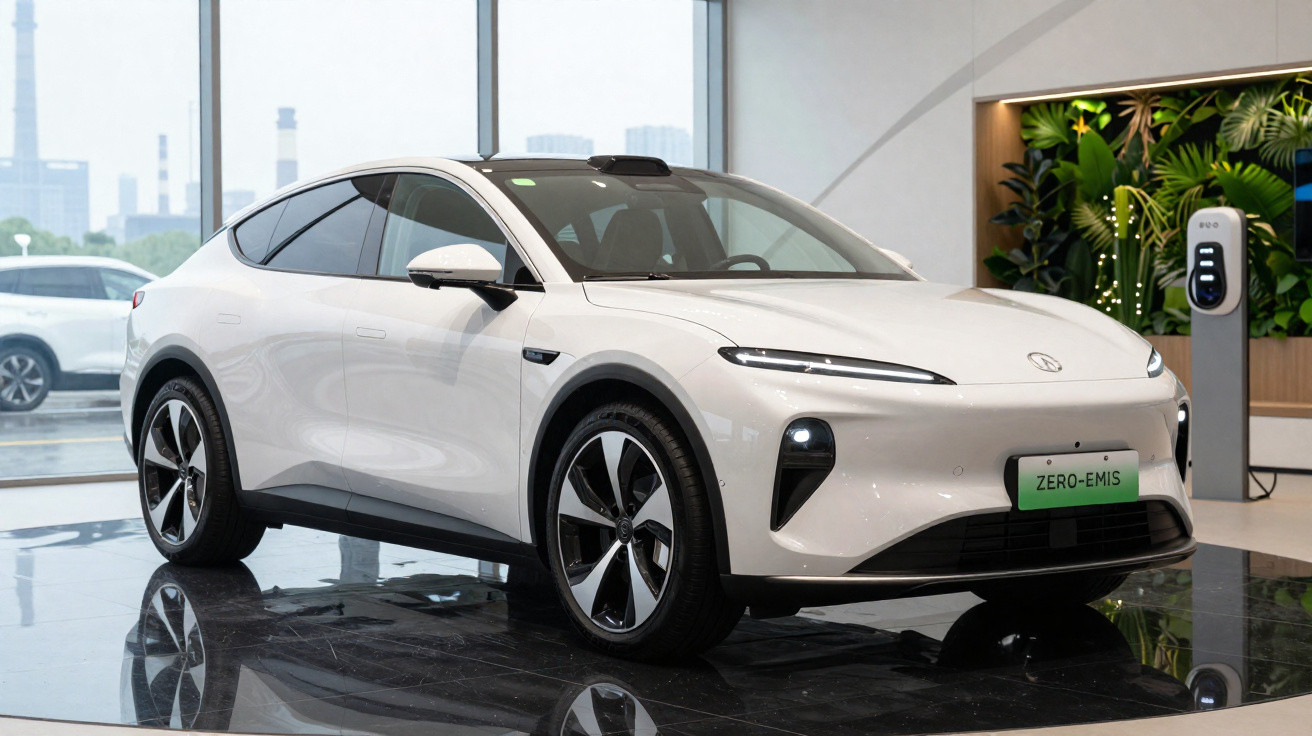
The salesperson drops his voice, like he’s about to share something confidential. You’re standing in an immaculate showroom with gentle music playing, your right hand on the flawless steering wheel of a brand‑new electric SUV. “Zero emissions,” he says, tapping a glossy brochure. Outside, a lit-up logo glows green, mirrored in the rain-dark tarmac. You imagine yourself floating quietly through town, skipping petrol stations, saving the planet on the way to the supermarket.
Then the doubts creep in. Where were the batteries made? Who mined the metals? And what, exactly, is generating the electricity feeding the socket in your garage when you plug in overnight? The salesperson grins and offers you the keys for a test drive. You grin back.
Still, an awkward thought stays with you in the rear‑view mirror.
Your “zero emissions” car started polluting long before you touched the wheel
For most of us, the clean narrative begins at the charging lead: a tidy dashboard symbol, a percentage ticking upwards, maybe a reassuring green leaf on the screen. That’s the part people like to focus on.
But the emissions story really starts much earlier - in mines, refineries, factories, container ships and power stations. Long before an electric car turns a wheel, an unseen trail of CO₂ has already been baked into its bodywork and, especially, its battery.
No one applauds when a lorry drops off battery cells at the production line. And nobody takes a selfie beside a cobalt mine.
Behind every polished electric-car advert sits a reality such as Chile’s Atacama desert, where vast brine pools spread out to evaporate water so lithium can be extracted. There’s a teenager in the Democratic Republic of Congo, crouched inside a tight tunnel, scraping out cobalt. There are enormous plants in China running day and night on coal‑heavy grids, pressing, welding and assembling battery modules at industrial pace.
A recent study from Volvo looking at its own electric SUV estimated that manufacturing the vehicle and its battery produced significantly more CO₂ than building the petrol equivalent. The electric version has to cover thousands of kilometres before it even draws level with a conventional engine. The “green” edge arrives late.
That mismatch exists because EV emissions are largely front‑loaded. Making a large battery, sourcing and refining scarce metals, and producing specialised electronics all require substantial energy and fuel out of sight. In effect, your later clean driving is paid for with a dirty deposit.
Once you’re moving, tailpipe emissions do fall to zero - that part is true. However, every kilometre you drive is still linked to the electricity mix where you charge. Plug into a grid dominated by coal and your quiet commute is indirectly powered by smokestacks beyond the city. Plug into wind, solar or nuclear and the calculation shifts.
The brochure almost never shows you that equation.
The calculation nobody wants to do on a Sunday night
To work out whether an electric car is genuinely greener, you have to do something dull and unforgiving: count the full life cycle. That means including emissions from raw-material extraction, battery production, vehicle assembly, electricity generation, driving, maintenance and end‑of‑life recycling.
There are online tools that attempt to estimate this, but they immediately demand details most people don’t have to hand. What is your local grid’s carbon intensity? How long will you keep the car? How large is the battery?
Most of us simply glance at the “zero emissions” badge and carry on. Honestly, hardly anyone runs these numbers day after day.
One couple in Berlin did try. They bought a small electric car, fitted a smart meter at home, and began recording every charging session, every journey and every kWh. They tracked Germany’s electricity mix hour by hour to estimate the actual CO₂ behind their supposedly clean trips. After a year, the husband - an engineer - had produced a spreadsheet thicker than a slim novel.
What he found surprised their friends: compared with a petrol car, their EV was far cleaner overall, but it looked nothing like the angelic image in advertising. Short city hops charged overnight on coal‑heavy power were particularly poor. Longer drives topped up during sunny, windy weekends came out unexpectedly well.
All of a sudden, a “green drive” wasn’t only about the car itself - it was about timing, location and behaviour.
This is the blunt reality of electric mobility: when you ask “is it green?”, the most accurate answer is usually “it depends”. It depends on where the metals were sourced, who made the batteries, how electricity is generated, how quickly you drive and even how often you replace vehicles.
A small, sensible EV kept for 12 years and charged mostly on renewables looks nothing like a two‑tonne luxury EV leased for three years and rapid‑charged on a coal‑heavy motorway network. Yet both can be sold as “zero emission”.
When all that complexity is reduced to a single green logo, it isn’t exactly a lie - it’s just the nicest slice of the story.
Driving greener starts before you ever press “Start”
If you already have an electric car - or you’re planning to buy one - the biggest improvement often isn’t more technology. It’s being willing to ask awkward questions. Begin with something simple: how much battery capacity do you truly need? Those headline ranges of 500+ km sound reassuring, but they also mean more materials, more mass and higher manufacturing emissions.
Many motorists discover their everyday routine would suit a smaller pack perfectly well. Less battery, less weight, fewer resources. One size rarely fits all - especially not in tonnes.
Then look at the power you’re using. Can you move to a greener tariff, or charge when your grid is cleaner - for instance, around mid‑day in sunny areas or on windy nights in coastal regions?
Another step, often missed amid the consumer rush, is simply to keep the car for longer. Replacing an EV every time the “latest” model lands effectively wipes away part of the climate benefit, because each new build starts the emissions clock again.
We all recognise that moment: a glossy new model appears in your feed and your three‑year‑old car suddenly feels outdated. Advertising is engineered to provoke exactly that response. Yet the greenest vehicle is often the one you already own - looked after properly, driven sensibly, and not swapped at the first scrape on the bumper.
Owning an electric car doesn’t automatically make every kilometre blameless.
There’s also a social dimension that rarely gets much attention. Your personal footprint isn’t isolated; it sits inside a shared system. Public transport, cycling, car clubs and even walking can cut the total number of batteries the world needs. An electric car isn’t a moral shield - it’s one tool among many.
“We jumped from ‘SUVs are bad’ to ‘electric SUVs are good’ without asking if we really needed SUVs in the first place,” sighs a French urban planner. “We changed the engine, not the habit.”
To steer through this, it helps to keep a few practical questions in view:
- Do I need a car for this particular trip, or is there a lower‑impact alternative?
- Is my vehicle sized for my life 95% of the time, or only for rare, extreme days?
- Am I charging at the cleanest possible times and places?
- Can I share, rent or borrow instead of owning a second (or bigger) car?
- Am I choosing image or impact with my next upgrade?
The scandal isn’t the car itself, it’s the story we buy with it
The deeper you look into electric-car emissions, the less tidy the picture becomes. You’ll find harmful mining practices alongside genuine improvements in urban air quality. You’ll see battery factories running on coal, and at the same time streets where children inhale less NO₂ because traffic has shifted to electric.
The scandal isn’t that electric cars create pollution - everything manufactured at scale does. The scandal lies in the sums people avoid when signing the finance agreement: lifetime emissions, the grid mix, and oversized vehicles dressed up as climate champions.
A more honest discussion would be less glamorous and far more useful. It would accept that electric cars can be a step forward, but not a free pass. It would recognise that some EVs are excessive, some charging habits are wasteful, and that walking to the bakery can sometimes beat driving - in any form.
Once that clicks, choosing an EV doesn’t stop being a choice. It simply becomes part of a broader, messier question: what kind of mobility future are we actually trying to create?
| Key point | Detail | Value for the reader |
|---|---|---|
| Production emissions matter | Battery and car manufacturing can emit more CO₂ upfront than a comparable petrol model | Helps you judge EVs beyond the “zero emissions” sticker |
| Electricity mix changes everything | Charging on coal‑heavy grids is far dirtier than charging on renewables or nuclear | Shows when and where your charging really counts for the climate |
| Size and lifespan are crucial | Smaller batteries and longer ownership drastically improve total impact | Guides you towards smarter purchases and usage habits |
FAQ:
- Do electric cars really pollute less than petrol cars?In most regions, yes over their full lifetime, especially once you drive enough kilometers. Yet the gap depends heavily on battery size, production methods and the cleanliness of your local electricity.
- How many kilometers do I need to drive to “offset” battery production?Studies vary, but many place the break‑even point between 20,000 and 80,000 km. Cleaner grids and smaller batteries push that number down; coal‑heavy grids and giant SUVs push it up.
- Is a hybrid car greener than a full electric?Often not in the long run. Hybrids carry two systems and still burn fuel. A modest full EV charged mostly on low‑carbon power usually wins over time.
- What’s the most ecological choice if I already own a petrol car?If your current car is in good shape and you drive little, keeping it longer and reducing trips may beat buying a new EV right now. High‑mileage drivers benefit more quickly from switching to electric.
- What should I look for when buying an EV with emissions in mind?Prioritize a smaller, lighter model that fits your real needs, check the manufacturer’s battery sourcing and energy use, and pair your purchase with a greener electricity contract when possible.


Comments
No comments yet. Be the first to comment!
Leave a Comment